<?xml version="1.0" encoding="utf-8"?><feed xmlns="http://www.w3.org/2005/Atom" ><generator uri="https://jekyllrb.com/" version="4.4.1">Jekyll</generator><link href="https://inl.info.ucl.ac.be/feed.xml" rel="self" type="application/atom+xml" /><link href="https://inl.info.ucl.ac.be/" rel="alternate" type="text/html" /><updated>2026-10-29T09:09:40+00:00</updated><id>https://inl.info.ucl.ac.be/feed.xml</id><title type="html">IP Networking Lab</title><subtitle>Site of the IP Networking Lab at UCLouvain.</subtitle><entry><title type="html">Improving the efficiency and flexibility of network communications</title><link href="https://inl.info.ucl.ac.be/phd/2026/09/02/navarre-phd.html" rel="alternate" type="text/html" title="Improving the efficiency and flexibility of network communications" /><published>2026-09-02T00:00:00+00:00</published><updated>2026-09-02T00:00:00+00:00</updated><id>https://inl.info.ucl.ac.be/phd/2026/09/02/navarre-phd</id><content type="html" xml:base="https://inl.info.ucl.ac.be/phd/2026/09/02/navarre-phd.html"><![CDATA[<p>Large-scale one-to-many events occur when many people want the same content at the same time. Historical use cases included IPTV, but while video-on-demand (VoD) applications rose in recent decades, demand for live streaming and large-scale software updates also increased significantly. One can think of the very recent (at the time of writing this blog) Grand Theft Auto 6 trailer, which Netflix released for only a few hours and which crashed the platform due to high demand. And we are not even talking about downloading the game, which should weigh more than 150 GB.
More examples of this have emerged in recent years, including live-streaming sports events, Fortnite, and software updates.</p>

<p>These demand spikes require network operators to shape their networks accordingly, creating an over-provisioning paradox: most of the time, networks have unused bandwidth, which is used only for these sporadic, large-scale one-to-many events.
In his thesis, <a href="https://uclouvain.be/fr/people/louis.navarre">Louis Navarre</a> explored this paradox in two different scopes.</p>

<h2 id="network-layer-forward-erasure-correction">Network-layer Forward Erasure Correction</h2>

<p>First, this spare bandwidth can improve quality of service by using Forward Erasure Correction (FEC) methods.
FEC techniques encode sent data, producing more output symbols so a receiver can recover from packet losses without packet retransmissions.
Such mechanisms usually apply at the data link and transport layers, e.g., in the QUIC protocol.
However, adoption requires standardization and consumes additional processing on end hosts.
As a first contribution, this thesis aimed to <a href="https://hdl.handle.net/2078.5/266683">provide such FEC capabilities as a service from within the network</a>.
Powered by IPv6 Segment Routing network programming, these FEC tunnels can be dynamically deployed.</p>

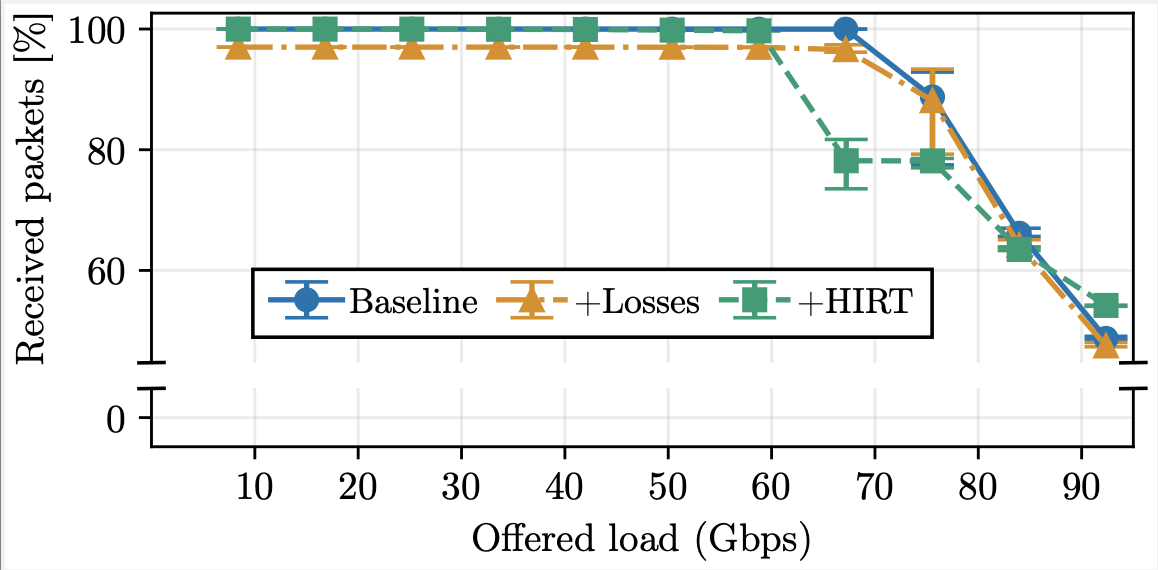
<p>Because network-layer work can require high-speed processing, this work focused on a rigorous software implementation starting from FastClick, achieving more than 60 Gbps of protected traffic under heavy losses (3%), as illustrated in the figure below.</p>

<p><img src="/assets/images/hirt-bench.png" width="500" /></p>

<p>Emulation is fine, but a real experiment is better.
We evaluated our system over the Starlink network, which is known to expose non-congestion-induced packet losses — which can be recovered using FEC.
The thesis presents numerous results showing that the approach improves the quality of service for latency-sensitive applications.</p>

<h2 id="flexicast-quic-in-the-end-it-is-all-about-multicast">Flexicast QUIC: “<em>In the end, it is all about multicast</em>.”</h2>

<p>The core contribution of this thesis focuses on <strong>why</strong> we need over-provisioning: content providers (e.g., CDNs) currently use unicast to distribute the same data to numerous receivers.
A more elegant solution is to rely on <em>multicast</em> protocols.
As illustrated below, multicast communication relies on the underlying network to efficiently replicate a single packet emitted by the source to all intended receivers. With multicast, at most a single copy of each packet flows in the network, making it an efficient delivery method.
Despite this, multicast is rarely deployed in practice because of numerous problems.</p>

<p>This thesis focuses on a subset of these problems at the transport layer.
With its modern features and large deployment (around 30% worldwide), <a href="https://www.rfc-editor.org/rfc/rfc9000.html">QUIC</a> is a natural candidate for solving some of these problems, but not all.
Multipath protocols have also emerged since researchers last considered multicast transport.
In this work, we reconsidered <em>multicast as a multipath problem</em>, resolving numerous issues.</p>

<p>The outcome of this idea led to <a href="https://hdl.handle.net/2078.5/268618"><strong>Flexicast QUIC (FCQUIC)</strong>, standing for <em>flexible multicast</em></a>.
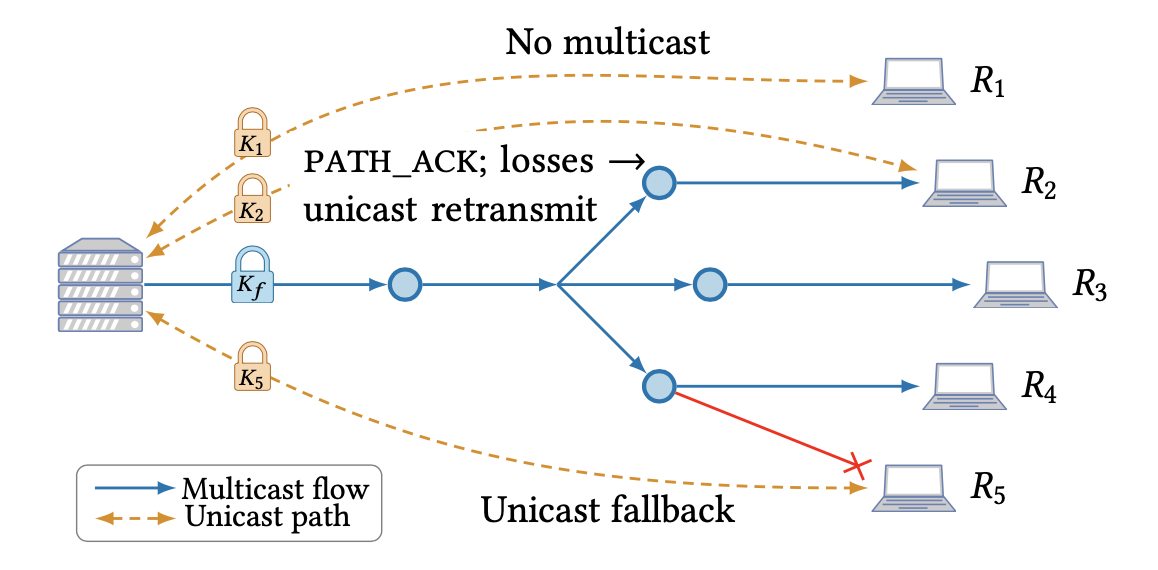
As shown below, FCQUIC exposes a per-receiver bidirectional unicast path and a shared unidirectional multicast flow.
The multicast flow efficiently conveys data to receivers (e.g., using an IP Multicast network below), while the individual unicast paths ensure reliability and robustness to failures or underperforming receivers; for example, bottleneck receivers can fall back to unicast to avoid degrading multicast communication.</p>

<p><img src="/assets/images/fcquic-design.png" width="500" /></p>

<p>The neat thing is that the transition between unicast and multicast is <em>seamless</em> for the receivers, as they view the multicast flow as another multipath path.
As such, unicast fallback, retransmissions, … are just multipath problems which have already been solved in the past.</p>

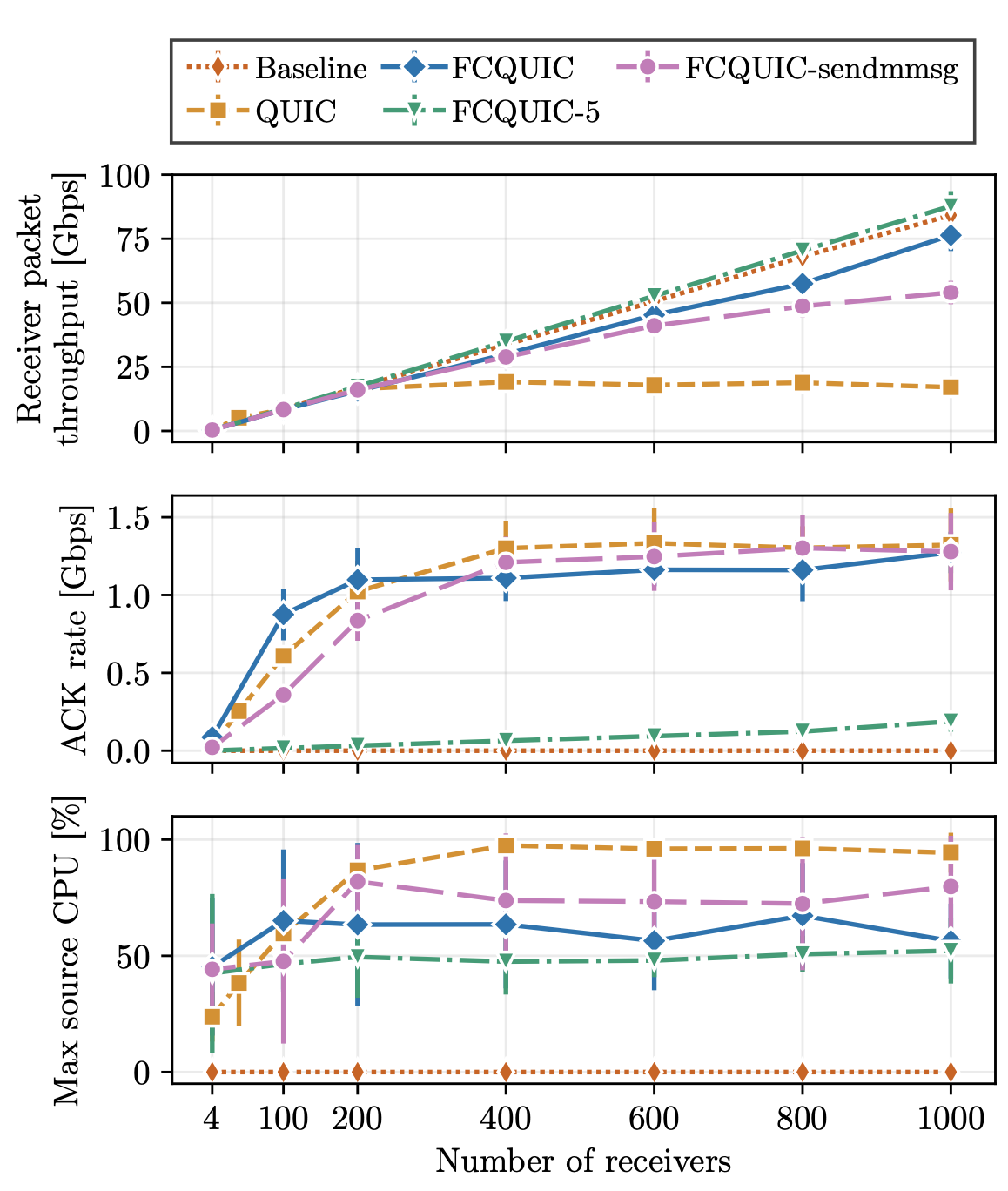
<p>We implemented Flexicast QUIC in Cloudflare quiche, aiming for scalability: a single server could sustain (at least) 1000 receivers for a cumulated throughput of ~80 Gbps.
We also considered bottleneck receivers, showing that a simple algorithm could detect them and fall back to unicast, improving the quality of experience for the other receivers in the group.</p>

<p><img src="/assets/images/fcquic-bench.png" width="500" /></p>

<p>In a second step, <a href="https://hdl.handle.net/2078.5/279520">we tackled the ACK implosion problem in multicast: a single data packet triggers as many acknowledgments as there are receivers</a>.
By knowing the exact number of active receivers, an FCQUIC source can dynamically advertise and update an acknowledgment delay that receivers use to pace their PATH_ACK frames.
Not only does this mechanism work, but we also studied its impact on the scalability of the Flexicast QUIC server: CPU usage (assuming it reflects the workload) is primarily influenced by the acknowledgment rate, which we can control with our mechanism.
This result lets us consider, at least theoretically, deployment at a larger scale than we could achieve with our limited setup.
This chapter also allowed us to consider the problem of loosely synchronized receivers for file delivery (think about these Fortnite updates).</p>

<h2 id="the-optimistic-acknowledgment-oack-attack">The Optimistic Acknowledgment (OACK) attack</h2>

<p>I will not explain how we found ourselves working on this topic, but we did.
The Optimistic Acknowledgment (OACK) attack is an attack where an end host (let us consider it the client) sends acknowledgments for packets not (yet) received, forcing its peer (the server) to increase its sending rate, and ultimately leading to Denial of Service attacks.</p>

<p>Think about the CUBIC congestion control algorithm: the only way CUBIC reduces the congestion window is after the detection of packet losses.
By sending these OACKs, the client hides potential losses from the server, which can indefinitely increase its sending rate until it saturates its own network.
The interesting point is that, because QUIC packets are mostly encrypted (and the ACK frames along with them), middleboxes cannot investigate the ACK contents before they reach the server.</p>

<p>Section 21.4 of RFC 9000 describes a way to detect the attack by randomly skipping packet numbers.
If the client cannot guess these skips, it will eventually send an ACK frame for this skipped packet number. Because packet numbers are unique and monotonically increasing during the connection lifetime, this should never happen.
In this chapter, we do not revoke this mechanism—it works—<a href="https://hdl.handle.net/2078.5/256525">but investigate whether QUIC implementations support the feature</a>.</p>

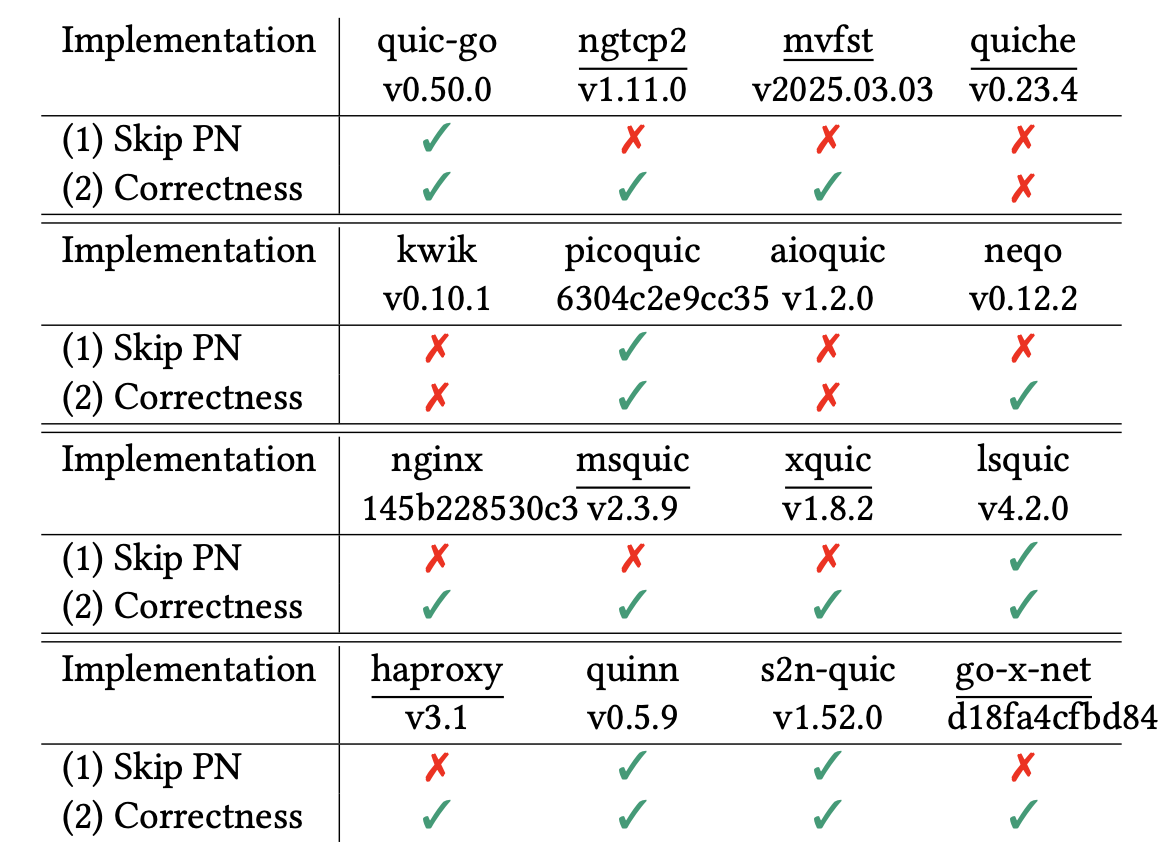
<p>We took the 16 available QUIC server implementations from the QUIC Interop Runner, and found that 11 of them did <strong>not</strong> skip packet numbers, and are exposed to the attack.
The next step was to produce the attack, but we needed an OACK predictor. The good news is that a very simple algorithm did the trick, and we managed to attack these 11 implementations: they all ended up sending faster than they should.
We also attacked a real CDN, with its explicit agreement, and showed that it was vulnerable to the attack.</p>

<p><img src="/assets/images/oack-vuln.png" width="500" /></p>

<p>This work led to discussions with the maintainers of the vulnerable implementations, and most of them patched their stack with the feature, including those from Alibaba, Meta, Microsoft, Cloudflare, …</p>

<h2 id="wrapping-it-up">Wrapping it up</h2>

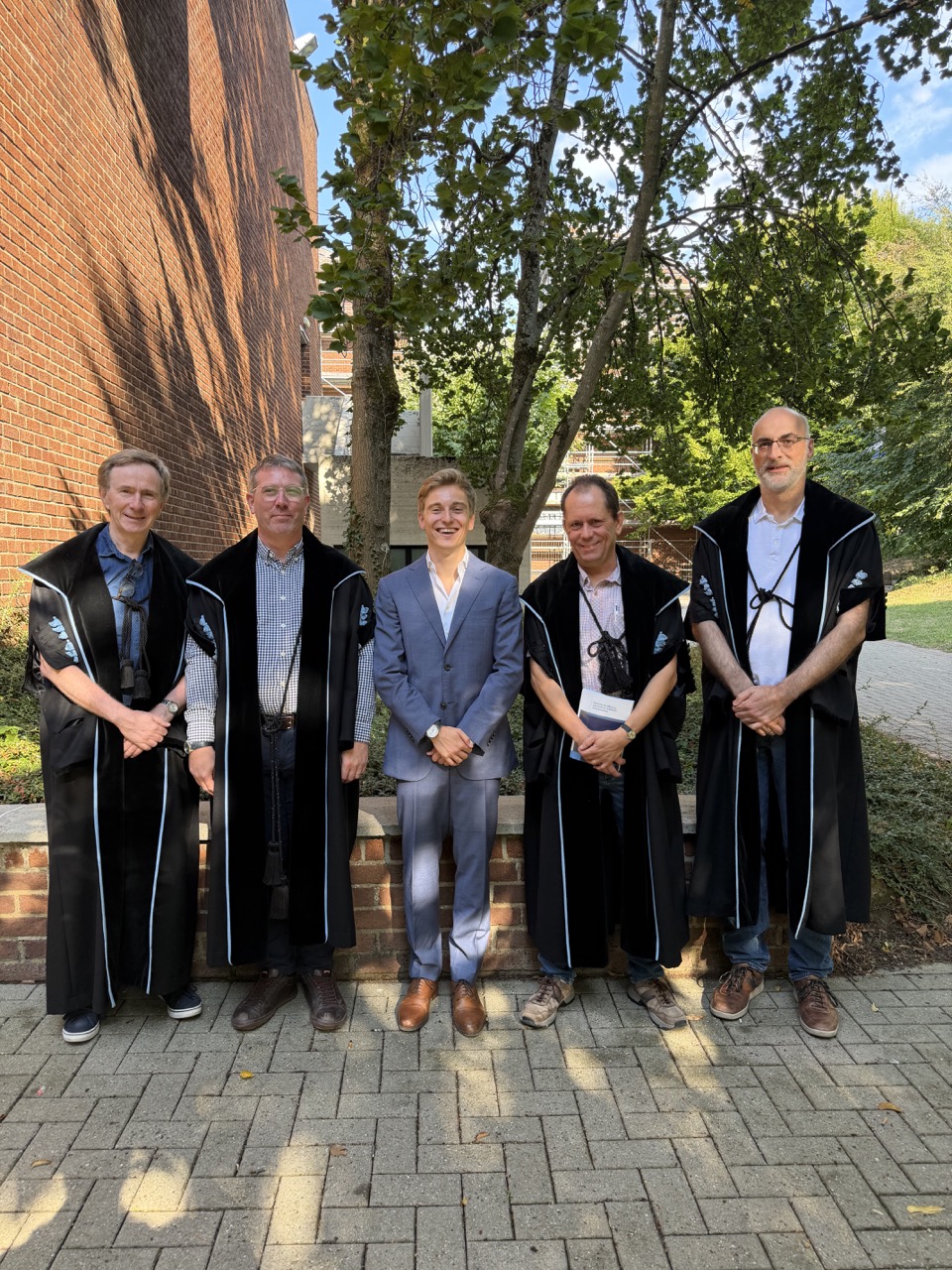
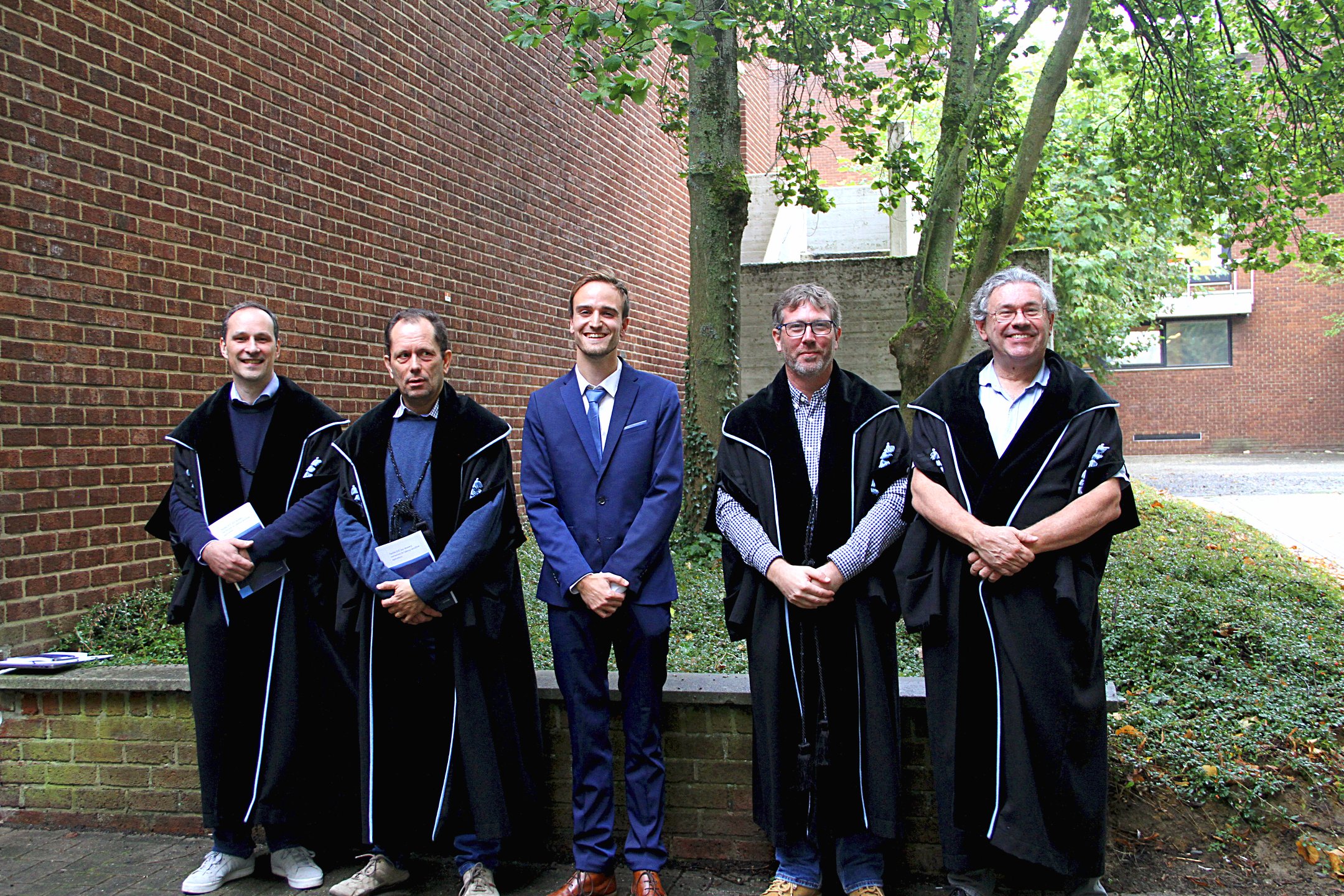
<p><a href="https://uclouvain.be/fr/people/louis.navarre">Louis Navarre</a> presented these results in his PhD thesis: <a href="/assets/pdf/navarre-phd.pdf">Improving the Efficiency and Flexibility of Network Communications</a>, which he successfully presented on August 26th, 2026.
This thesis is just one of many contributions needed to solve multicast’s historical problems. We just focused on transport-layer issues (and not all of them).
More work is needed if we aim to deploy multicast at the Internet level.
At the end of the thesis, we discuss ideas to extend this work, but we hope this contribution is just the first of many more to come.</p>

<p>Stay tuned at the IP Networking Lab!</p>

<p><img src="/assets/images/navarre-phd.jpeg" alt="Photo" /></p>]]></content><author><name>Louis Navarre, IP Networking Lab</name></author><category term="phd" /><category term="quic," /><category term="multicast," /><category term="flexicast," /><category term="fec" /><summary type="html"><![CDATA[Large-scale one-to-many events occur when many people want the same content at the same time. Historical use cases included IPTV, but while video-on-demand (VoD) applications rose in recent decades, demand for live streaming and large-scale software updates also increased significantly. One can think of the very recent (at the time of writing this blog) Grand Theft Auto 6 trailer, which Netflix released for only a few hours and which crashed the platform due to high demand. And we are not even talking about downloading the game, which should weigh more than 150 GB. More examples of this have emerged in recent years, including live-streaming sports events, Fortnite, and software updates.]]></summary><media:thumbnail xmlns:media="http://search.yahoo.com/mrss/" url="https://inl.info.ucl.ac.be/assets/images/navarre-phd.jpeg" /><media:content medium="image" url="https://inl.info.ucl.ac.be/assets/images/navarre-phd.jpeg" xmlns:media="http://search.yahoo.com/mrss/" /></entry><entry><title type="html">UCLouvain researchers at IETF126</title><link href="https://inl.info.ucl.ac.be/ietf/2026/08/11/ietf126.html" rel="alternate" type="text/html" title="UCLouvain researchers at IETF126" /><published>2026-08-11T00:00:00+00:00</published><updated>2026-08-11T00:00:00+00:00</updated><id>https://inl.info.ucl.ac.be/ietf/2026/08/11/ietf126</id><content type="html" xml:base="https://inl.info.ucl.ac.be/ietf/2026/08/11/ietf126.html"><![CDATA[<p>Three researchers from the lab attended IETF126 in Vienna, Austria.
<a href="/members/louis-navarre.html">Louis Navarre</a> championned a Hackathon on a minimal implementation of Multicast QUIC.
They were able to live stream Louis’s Macbook webcam to 4 other devices (2 laptops and 2 phones) using their minimal Multicast QUIC implementation.
They modified three implementations: quiche, aioquic &amp; quinn.
Additionally, <a href="/members/anthony-doeraene.html">Anthony Doeraene</a> presented his paper on extending PIM to expose network capabilities for modern multicast at the ANRW 2026.</p>]]></content><author><name>Vany V. Ingenzi</name></author><category term="ietf" /><category term="quic," /><category term="multicast" /><summary type="html"><![CDATA[Three researchers from the lab attended IETF126 in Vienna, Austria. Louis Navarre championned a Hackathon on a minimal implementation of Multicast QUIC. They were able to live stream Louis’s Macbook webcam to 4 other devices (2 laptops and 2 phones) using their minimal Multicast QUIC implementation. They modified three implementations: quiche, aioquic &amp; quinn. Additionally, Anthony Doeraene presented his paper on extending PIM to expose network capabilities for modern multicast at the ANRW 2026.]]></summary><media:thumbnail xmlns:media="http://search.yahoo.com/mrss/" url="https://inl.info.ucl.ac.be/assets/images/ietf-126.png" /><media:content medium="image" url="https://inl.info.ucl.ac.be/assets/images/ietf-126.png" xmlns:media="http://search.yahoo.com/mrss/" /></entry><entry><title type="html">UCLouvain researchers at IETF118</title><link href="https://inl.info.ucl.ac.be/ietf/2023/11/03/ietf118.html" rel="alternate" type="text/html" title="UCLouvain researchers at IETF118" /><published>2023-11-03T00:00:00+00:00</published><updated>2023-11-03T00:00:00+00:00</updated><id>https://inl.info.ucl.ac.be/ietf/2023/11/03/ietf118</id><content type="html" xml:base="https://inl.info.ucl.ac.be/ietf/2023/11/03/ietf118.html"><![CDATA[<p>Four researchers from UCLouvain will attend <a href="https://www.ietf.org/how/meetings/118/">IETF118</a> in Prague. IETF meetings are important for researchers who develop or enhance Internet protocols because they encourage interactions with engineers who deploy these protocols at a large scale. At IETF118, UCLouvain contributions will focus on QUIC, TCP, TLS and BGP.</p>

<p><a href="https://uclouvain.be/fr/repertoires/francois.michel">François Michel</a> proposes in <a href="https://datatracker.ietf.org/doc/draft-michel-quic-fec/">draft-michel-quic-fec</a> a QUIC extension to support Forward Erasure Correction (FEC). This enables QUIC to carry latency sensitive services and leverages all the lessons that he learned in adding FEC support in three different QUIC implementations during his PhD.</p>

<p>In parallel, Multipath QUIC continues to progress with a new version of <a href="https://datatracker.ietf.org/doc/draft-ietf-quic-multipath/">draft-ietf-quic-multipath</a> with minor changes. In contrast with Multipath TCP, the current version of Multipath QUIC does not allow a client to learn the different addresses of a server. In <a href="https://datatracker.ietf.org/doc/draft-piraux-quic-additional-addresses/">draft-piraux-quic-additional-addresses</a>, <a href="https://uclouvain.be/fr/repertoires/maxime.piraux">Maxime Piraux</a> proposes a QUIC extension to exchange this information and notably support dual-stack servers.</p>

<p><a href="https://uclouvain.be/fr/repertoires/louis.navarre">Louis Navarre</a> works on enabling QUIC to use IP multicast to carry data to a large number of receivers. He has proposed a <a href="https://arxiv.org/abs/2309.06633">new design and experimented</a> with an implementation in Cloudflare’s quiche. He has contributed some of his findings to the <a href="https://github.com/GrumpyOldTroll/draft-jholland-quic-multicast">Multicast QUIC draft</a>.</p>

<p>In addition to being used to support HTTP/3 or DNS, QUIC is also proposed to support other types of services. <a href="https://uclouvain.be/fr/repertoires/thomas.wirtgen">Thomas Wirtgen</a> and <a href="https://uclouvain.be/fr/repertoires/nicolas.rybowski">Nicolas Rybowski</a> have shown that it is possible to <a href="https://arxiv.org/abs/2304.02992">use QUIC to support BGP and OSPF</a>. From a security viewpoint, one of the benefits of QUIC over TCP is that QUIC can counter packet injection packets. TCP can counter such attacks by using the TCP-AO option to authenticate the TCP packets. Unfortunately, TCP-AO is cumbersome for network operators since they need to specify security keys for their BGP sessions. <a href="https://uclouvain.be/fr/repertoires/maxime.piraux">Maxime Piraux</a> and <a href="https://uclouvain.be/fr/repertoires/thomas.wirtgen">Thomas Wirtgen</a> propose in <a href="https://datatracker.ietf.org/doc/draft-piraux-tcp-ao-tls/">draft-piraux-tcp-ao-tls</a> to use the TLS handshake to automatically derive the TCP-AO security keys. <a href="https://uclouvain.be/fr/repertoires/thomas.wirtgen">Thomas Wirtgen</a> proposes in <a href="https://datatracker.ietf.org/doc/draft-wirtgen-bgp-tls/">draft-wirtgen-bgp-tls</a> to use TLS over TCP to support BGP and leverage this extension for TCP-AO.</p>]]></content><author><name>Olivier Bonaventure, IP Networking Lab</name></author><category term="ietf" /><category term="quic," /><category term="bgp" /><summary type="html"><![CDATA[Four researchers from UCLouvain will attend IETF118 in Prague. IETF meetings are important for researchers who develop or enhance Internet protocols because they encourage interactions with engineers who deploy these protocols at a large scale. At IETF118, UCLouvain contributions will focus on QUIC, TCP, TLS and BGP.]]></summary><media:thumbnail xmlns:media="http://search.yahoo.com/mrss/" url="https://inl.info.ucl.ac.be/assets/images/ietf.svg" /><media:content medium="image" url="https://inl.info.ucl.ac.be/assets/images/ietf.svg" xmlns:media="http://search.yahoo.com/mrss/" /></entry><entry><title type="html">Flexible QUIC loss recovery mechanisms for latency-sensitive applications</title><link href="https://inl.info.ucl.ac.be/phd/2023/10/12/michel-phd.html" rel="alternate" type="text/html" title="Flexible QUIC loss recovery mechanisms for latency-sensitive applications" /><published>2023-10-12T00:00:00+00:00</published><updated>2023-10-12T00:00:00+00:00</updated><id>https://inl.info.ucl.ac.be/phd/2023/10/12/michel-phd</id><content type="html" xml:base="https://inl.info.ucl.ac.be/phd/2023/10/12/michel-phd.html"><![CDATA[<p>Transport protocols such as TCP cope with packet losses by using acknowledgments and retransmissions. This technique is also used by recent protocols such as <a href="https://www.rfc-editor.org/rfc/rfc9000.html">QUIC</a>. Using retransmissions is the best approach to cope with packet losses from a bandwidth viewpoint, but they cause increases in delays and can affect latency sensitive applications.</p>

<p>Retransmissions are not the only technique to cope with packet losses. Forward Erasure Correction techniques encode the data sent by the source such that the receiver can extract missing packets from the information received. A very simple technique is to use XOR to encode the packets sent by the source. Such a XOR-based technique was <a href="https://dl.acm.org/doi/pdf/10.1145/3098822.3098842">added in an early prototype of QUIC</a>, but it achieved limited performance, mainly because this simple technique could not cope with burst losses that are frequent.</p>

<p>This motivated <a href="https://uclouvain.be/fr/repertoires/francois.michel">François Michel</a> to explore in details how Forwared Erasure Correction could be efficiently added to a modern transport protocol like QUIC. He started with a first prototype supporting XOR, Reed-Solomon and Convolutional RLC. His results, published in <a href="https://dial.uclouvain.be/pr/boreal/object/boreal:217933">QUIC-FEC: Bringing the benefits of Forward Erasure Correction to QUIC</a> confirmed that FEC can provide benefits compared to retransmissions.</p>

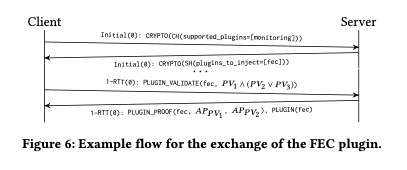
<p>One concern with FEC is that there are many techniques which can be used to encode the data and the best technique may depend on the type of application and the capabilities of the clients and the server. It could be difficult for all server and clients to support all possible FEC techniques. In <a href="http://hdl.handle.net/2078.1/218857">Pluginizing QUIC</a>,  <a href="https://uclouvain.be/fr/repertoires/francois.michel">François Michel</a> demonstrated that it is possible to dynamically extend a QUIC implementation using plugins. The <a href="https://github.com/private-octopus/picoquic">picoquic</a> implementation was enhanced with an <a href="https:ebpf.io">eBPF</a> and several modules that enable it to be dynamically extended with eBPF code exchanged over the QUIC connection as illustrated in the figure below.</p>

<p><img src="/assets/images/pquic-fec.png" alt="PQUIC exhanges plugins" /></p>

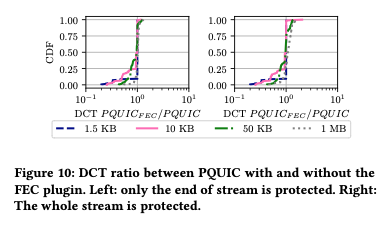
<p>Once the eBPF bytecode has been exchanged, the remote host can use FEC on this particular connection. The article showed that by protecting only the last packets of short file transfers it was possible to reduce the download completion time without causing an important overhead.</p>

<p><img src="/assets/images/pquic-results.png" alt="PQUIC last packets" /></p>

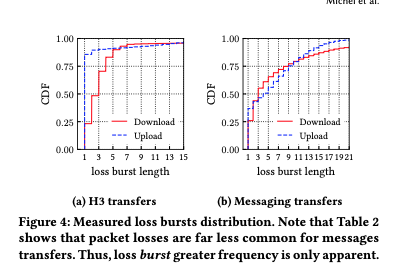
<p>In parallel with extending QUIC,  <a href="https://uclouvain.be/fr/repertoires/francois.michel">François Michel</a> studied the performance of the Starlink network and showed in <a href="http://hdl.handle.net/2078.1/265896">A First Look at Starlink Performance</a> that packet losses occur in this recent access technology.</p>

<p><img src="/assets/images/starlink-loss.png" alt="packet losses in Starlink" /></p>

<p>Starlink and the future satellite constellations is an important motivation for realizing FEC in QUIC to support latency sensitive applications. In <a href="http://hdl.handle.net/2078.1/264704">FlEC: Enhancing QUIC with application-tailored reliability mechanisms</a>, <a href="https://uclouvain.be/fr/repertoires/francois.michel">François Michel</a> showed that it is possible to adjust the transmission rate of the FEC, and thus the overhead, to the application needs and evaluates the performance of the proposed scheme with measurements in emulated networks and using Starlink.</p>

<p><a href="https://uclouvain.be/fr/repertoires/francois.michel">François Michel</a> has summarized all the lessons in learned while designing and improving Forward Erasure Correction during the last five years in the Ph.D. thesis <a href="/assets/pdf/michel-phd.pdf">Flexible QUIC loss recovery mechanisms for latency-sensitive applications</a> that he successfully presented on October 12th, 2023.</p>

<p><img src="/assets/images/michel-phd.jpg" alt="Photo" /></p>]]></content><author><name>Olivier Bonaventure, IP Networking Lab</name></author><category term="phd" /><category term="quic," /><category term="fec," /><category term="starlink" /><summary type="html"><![CDATA[Transport protocols such as TCP cope with packet losses by using acknowledgments and retransmissions. This technique is also used by recent protocols such as QUIC. Using retransmissions is the best approach to cope with packet losses from a bandwidth viewpoint, but they cause increases in delays and can affect latency sensitive applications.]]></summary><media:thumbnail xmlns:media="http://search.yahoo.com/mrss/" url="https://inl.info.ucl.ac.be/assets/images/michel-phd.jpg" /><media:content medium="image" url="https://inl.info.ucl.ac.be/assets/images/michel-phd.jpg" xmlns:media="http://search.yahoo.com/mrss/" /></entry><entry><title type="html">Improving the Agility of BGP Routing</title><link href="https://inl.info.ucl.ac.be/phd/2023/10/04/wirtgen.html" rel="alternate" type="text/html" title="Improving the Agility of BGP Routing" /><published>2023-10-04T00:00:00+00:00</published><updated>2023-10-04T00:00:00+00:00</updated><id>https://inl.info.ucl.ac.be/phd/2023/10/04/wirtgen</id><content type="html" xml:base="https://inl.info.ucl.ac.be/phd/2023/10/04/wirtgen.html"><![CDATA[<p>Researchers of <a href="https://www.uclouvain.be">UCLouvain’s</a> <a href="https://inlold.info.ucl.ac.be">IP Networking Lab</a> regularly contribute to different Internet protocols. During the last four years, <a href="https://uclouvain.be/fr/repertoires/thomas.wirtgen">Thomas Wirtgen</a> has acquired a strong expertise in routing protocols. These protocols play a important role in the Internet since they control the paths that packet follows. There are two main classes on unicast routing protocols: <em>(i)</em> the intradomain routing protocols such as IS-IS and OSPF that are used inside enterprise and ISP networks and <em>(ii)</em> the Border Gateway Protocol (BGP) that is used to exchange routes between networks belonging to different companies. BGP is the glue that makes the Internet work.</p>

<p><a href="https://uclouvain.be/fr/repertoires/thomas.wirtgen">Thomas Wirtgen</a>
has developed several new techniques to make the routing protocols easier to extend. He first demonstrated in <a href="https://inlold.info.ucl.ac.be/system/files/document.pdf">The Case for Pluginized Routing Protocols</a> that it is possible to modify the implementation of routing protocols in a way to make them more extensible. For this, he leveraged the <a href="https://ebpf.io">eBPF</a> virtual machine and modified <a href="https://frrouting.org">FRRouting</a> such that key parts of this implementation could be extended by using small software modules called plugins that are written in C and compiled into eBPF before being executed inside FRRouting to extend.</p>

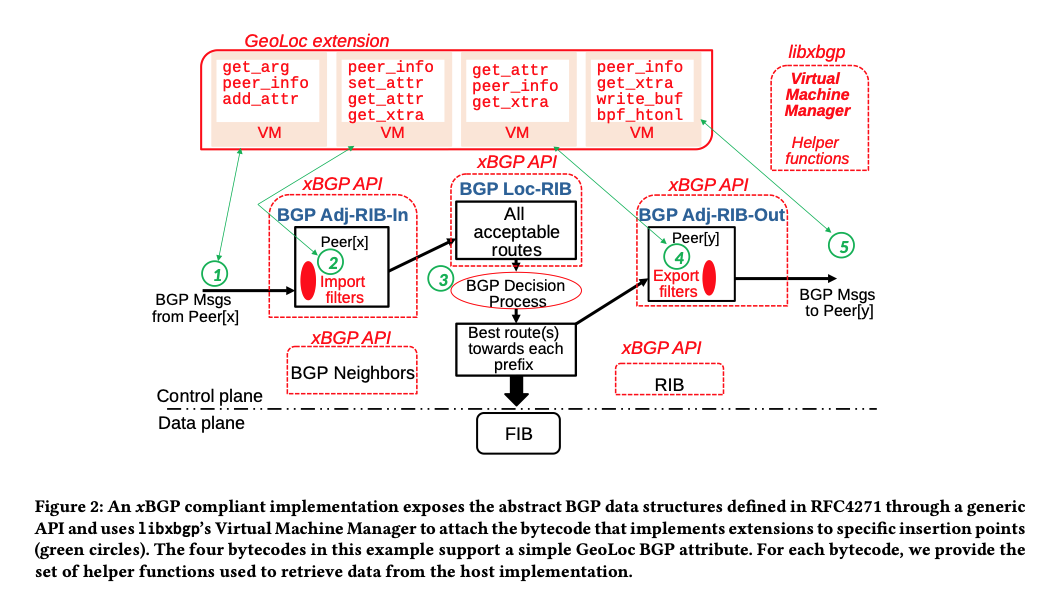
<p>This work showed that it is possible to extend one particular implementation with plugins, but it could only be used with FRRouting while most ISPs networks use routers from multiple vendors. <a href="https://uclouvain.be/fr/repertoires/thomas.wirtgen">Thomas Wirtgen</a> took a step back and analyzed what were the common factors among different implementations of BGP. They all need to implement the IETF standards and thus process the BGP messages according to the workflow specified in the standards. This was the starting point for his efforts on xBGP, a framework to enable different BGP implementations to be extensible. The initial idea was presented at HotNets’20 in the <a href="https://dial.uclouvain.be/pr/boreal/object/boreal%3A232421/datastream/PDF_02/view">xBGP: When You Can’t Wait for the IETF and Vendors</a> paper. The figure below illustrates the xBGP workflow and how it can be extended by plugins to support a protocol extension that allows to encode the geographical coordinates of the router where a given route was learned. A key contribution of this paper was that two different implementations, <a href="https://frrouting.org">FRRouting</a> and <a href="https://bird.network.cz">BIRD</a> can run exactly the same plugins written using eBPF.</p>

<p><img src="/assets/images/xbgp-1.png" alt="xbgp" /></p>

<p>However, this was not the end of the efforts on realizing xBGP. To convince researchers and network operators of the feasibility of this approach, <a href="https://uclouvain.be/fr/repertoires/thomas.wirtgen">Thomas Wirtgen</a> had to develop more use cases and prove that the plugins that were added to a BGP implementation could be executed safely. This was done notably in cooperation with Tom Rousseaux and Axel Legay who helped to prove this safety by relying on formal methods and tools. This effort was summarized in the paper <a href="https://www.usenix.org/conference/nsdi23/presentation/wirtgen">xBGP: Faster Innovation in Routing Protocols</a> that <a href="https://uclouvain.be/fr/repertoires/thomas.wirtgen">Thomas Wirtgen</a> presented at Usenix NSDI’23.</p>

<p><img src="/assets/images/wirtgen-phd.jpg" alt="PhD photo" /></p>

<p>These results are part of the Ph.D. thesis that <a href="https://uclouvain.be/fr/repertoires/thomas.wirtgen">Thomas Wirtgen</a> successfully defended on October 4th, 2023.</p>]]></content><author><name>Olivier Bonaventure, IP Networking Lab</name></author><category term="phd" /><category term="bgp," /><category term="routing" /><summary type="html"><![CDATA[Researchers of UCLouvain’s IP Networking Lab regularly contribute to different Internet protocols. During the last four years, Thomas Wirtgen has acquired a strong expertise in routing protocols. These protocols play a important role in the Internet since they control the paths that packet follows. There are two main classes on unicast routing protocols: (i) the intradomain routing protocols such as IS-IS and OSPF that are used inside enterprise and ISP networks and (ii) the Border Gateway Protocol (BGP) that is used to exchange routes between networks belonging to different companies. BGP is the glue that makes the Internet work.]]></summary><media:thumbnail xmlns:media="http://search.yahoo.com/mrss/" url="https://inl.info.ucl.ac.be/assets/images/wirtgen-phd.jpg" /><media:content medium="image" url="https://inl.info.ucl.ac.be/assets/images/wirtgen-phd.jpg" xmlns:media="http://search.yahoo.com/mrss/" /></entry><entry><title type="html">Best of CCR: The Packet Number Space Debate in Multipath QUIC</title><link href="https://inl.info.ucl.ac.be/inl/2023/08/23/pns-debate-ccr.html" rel="alternate" type="text/html" title="Best of CCR: The Packet Number Space Debate in Multipath QUIC" /><published>2023-08-23T00:00:00+00:00</published><updated>2023-08-23T00:00:00+00:00</updated><id>https://inl.info.ucl.ac.be/inl/2023/08/23/pns-debate-ccr</id><content type="html" xml:base="https://inl.info.ucl.ac.be/inl/2023/08/23/pns-debate-ccr.html"><![CDATA[<p>One of our recent publications in the SIGCOMM Computer Communication
Review (CCR) journal, “<a href="https://dl.acm.org/doi/abs/10.1145/3561954.3561956">The Packet Number Space Debate in Multipath QUIC</a>”,
has been selected to be part of the “Best of CCR” session at the
upcoming <a href="https://conferences.sigcomm.org/sigcomm/2023/">ACM SIGCOMM 2023 conference</a>.
Let us introduce in this blog post the context in which that work
relates and the impact it had regarding the <a href="https://datatracker.ietf.org/doc/draft-ietf-quic-multipath/">standardisation effort of
Multipath QUIC at the IETF</a>.</p>

<p>While our first proposals to bring multipath into QUIC date back from
2017 (both as an <a href="https://dl.acm.org/doi/abs/10.1145/3143361.3143370">ACM CoNEXT 2017 publication</a>
and as an <a href="https://datatracker.ietf.org/doc/draft-deconinck-multipath-quic/">IETF draft</a>),
it only gained
interest from the network community since 2020 and the publication of two other
alternate proposals, one being authored by Alibaba. However, the presence of
multiple proposals actually delayed the start of the Multipath QUIC standardization
effort, as most of them were very specific to their use-cases (some more adapted to
address mobility, others to Quality of Experience scheduling).</p>

<p>To make progress, the authors of the different proposals agreed to identify
the core elements that any Multipath QUIC implementation must include.
This led to the writting of the common proposal in October 2021, which
served as the basis of the adopted Multipath QUIC draft at the IETF. These
three proposals actually share most of the multipath extension principles.
The extension is negotiated using a QUIC transport parameter, multiple paths
can only be used after the session handshake completes, different Connection
IDs are used over different network paths, path creation is based on the
<a href="https://www.rfc-editor.org/rfc/rfc9000.html#name-path-validation">QUIC path validation mechanism</a>, 
and they all override the default <a href="https://www.rfc-editor.org/rfc/rfc9000.html#name-connection-migration">connection migration one</a>.</p>

<p>Despite all these similarities, there was a core design element of multipath
QUIC where proposals have different approaches: how QUIC packets should be
numbered. In single-path QUIC, once the handshake completes, all the remaining
packets share a single application data packet number space. Packet numbers
are monotonically increasing and never reused (i.e., packets are never
retransmitted, but their content can be). The receiver can then acknowledge the
reception of packets using ACK frames. Such ACK frames include ranges of
received packets as well as the delay between the reception of the largest
packet number and the transmission of the frame. This approach enables single-path
QUIC to provide efficient and accurate loss recovery. On the one hand, one of the
Multipath QUIC proposals suggests that this single packet number space can be
shared among the different paths. For instance, packet N could be sent on one path
and packet N+1 on another one. On the other hand, the two other proposals
argue for path-dedicated, contiguous packet number spaces. Each packet number space
would have its own identifier and each path could have a given packet N, where each
path would have its own.</p>

<table>
  <tbody>
    <tr>
      <td><img src="/assets/images/pns-mpquic.png" alt="Packet numbering options" /></td>
    </tr>
  </tbody>
</table>

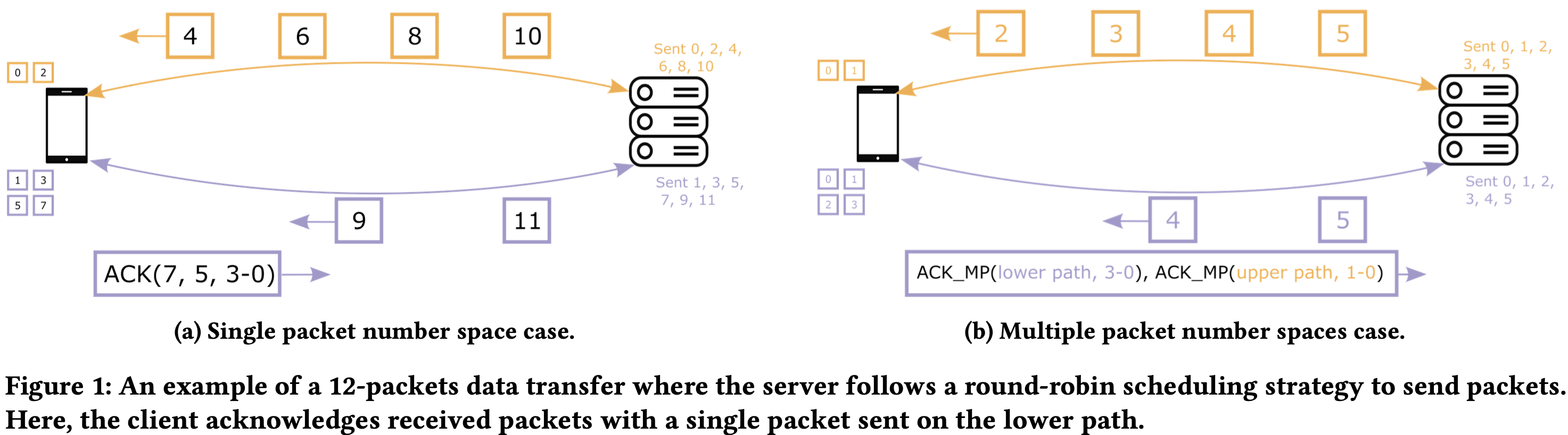
<p>The above figure summarizes the difference between the Single Packet
Number Space (SPNS) design and the Multiple Packet Number Spaces (MPNS)
one. Each design has its pros and cons. SPNS, unlike MPNS, does not
introduce any new frames on the wire (MPNS requires a new ACK_MP frame),
does not change encryption internals (i.e., the nonce) and
implementation experience reported less introduced code paths. On the
other side, spreading packets numbers on different network paths having
heterogeneous characteristics (bandwidth, delay,…) complexifies the
recovery algorithm at the sender side and can make it hard for the
sender to get accurate delay estimation of slow paths. SPNS also
requires futher adaptation when, e.g., using ECN.</p>

<p>Yet, the SPNS design introduces transfer performance variability due to
how the receiver maintains state regarding packets to acknowledge. In
QUIC, receivers implement heuristics aiming at discarding old packet
numbers from new acknowledgment reports and limiting the number of
acknowledgment ranges. For instance, the <a href="https://github.com/private-octopus/picoquic"><code class="language-plaintext highlighter-rouge">picoquic</code> implementation</a>,
one of the QUIC implementations supporting both numbering designs,
limits the number of acknowledged ranges to 33. Furthermore, to keep
bounded memory usage, many implementations integrate an <em>ACK horizon</em>
mechanism where incoming packets with a number lower than a given
threshold are considered as duplicate and therefore discarded. While
picoquic implements a dynamic threshold depending on the perceived delay, 
such a threshold is often the value of the largest packet number seen
minus a constant (127 being used in several implementations). In case of
large out-of-order packet number reception, this may lead the receiver to
not acknowledge packets (low ACK range limit), or even to discard valid
packets (low ACK horizon).</p>

<p>To study such cases with high reordering at server side, we consider a
bulk download of a 50 MB file over a single stream. We rely on picoquic,
supporting both SPNS and MPNS variants (the paper also considers
<a href="https://dl.acm.org/doi/10.1145/3341302.3342078">PQUIC</a> with the multipath
plugin that only supports MPNS, see the paper for details). We consider the
<a href="https://www.nsnam.org/about/projects/direct-code-execution/">NS3-DCE</a>
platform allowing to simulate network transfers with actual implementations,
offering results with very low variability. We adopt an experimental
design approach by considering 95 different 2-path configurations where the
summed bandwidth of the paths is 100 Mbps and their summed RTT is 200 ms.
Such an approach should provide network configurations where the expected
completion time remains similar.</p>

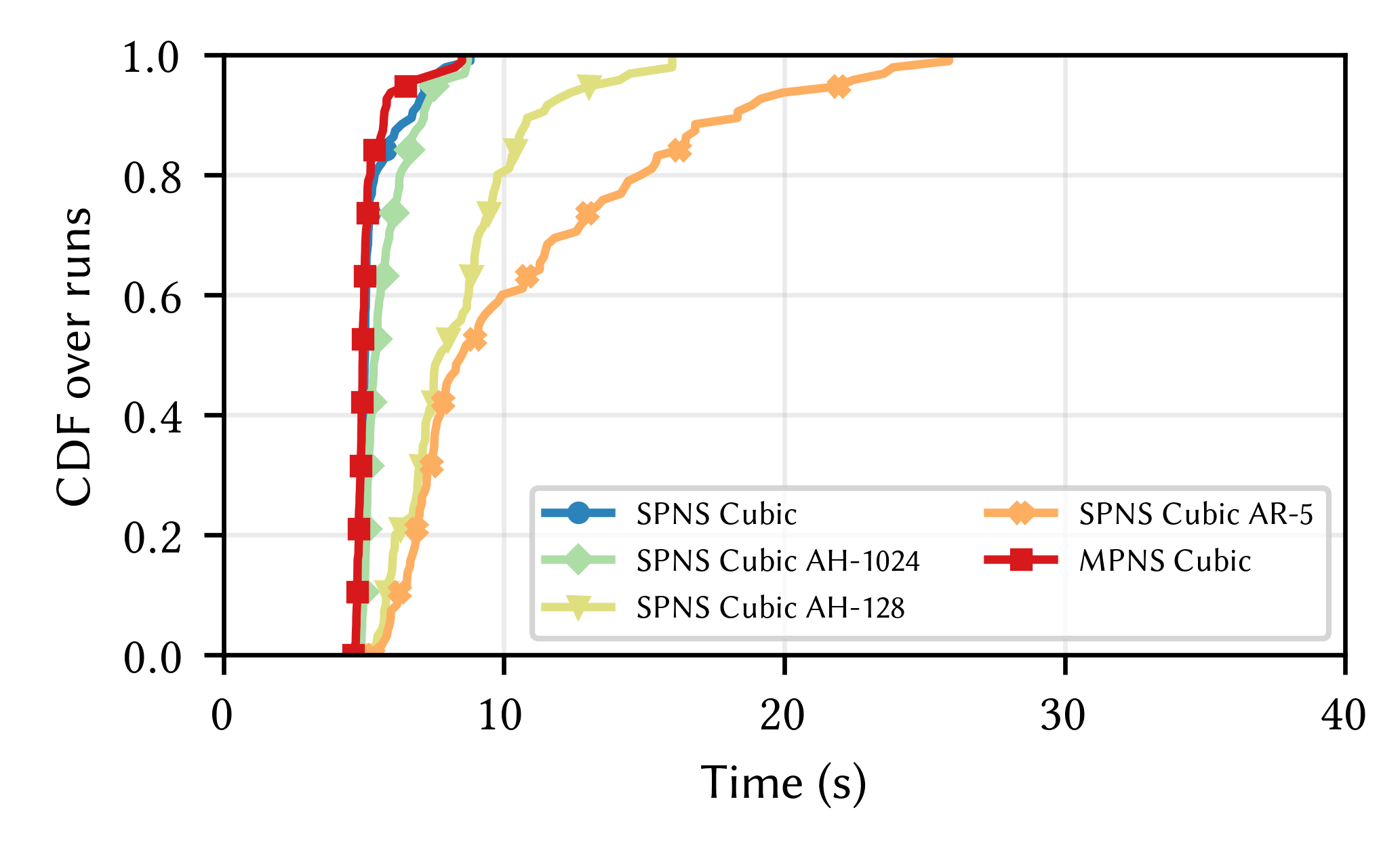
<table>
  <tbody>
    <tr>
      <td><img src="/assets/images/pns-fig1.png" alt="Completion time of 2-path configurations" /></td>
    </tr>
  </tbody>
</table>

<p>The above figure show that while the performance of both designs with the
default picoquic configuration are similar, we notice that SPNS has some
performance decrease on configurations showing a large delay ratio between
the paths (i.e., one path has a latency at least 4 times larger than the
other). MPNS is less affected by such path delay asymmetry. If we now
consider the receiver’s algorithms regarding ACK Range limitation (AR) and
fixed ACK Horizon threshold (AH), we note that they strongly affect the
performance of the traffic. While limiting the ACK range to 5 seems a bit
extreme, several QUIC production implementations integrate a fixed ACK
Horizon of 128. These lead to unacknowledged or dropped packets, implying
spurious retransmissions and transfer stalls, hence limiting the transfer
efficiency. On the other hand, the MPNS design is insensitive to these
receiver’s heuristics as there is no out-of-order packet number reception
due to the use of other paths.</p>

<p>While the effect of reordering is already visible on 2-path topologies,
adding more heterogeneous paths would worsen the aforementioned issues. To
assess this, we now consider 95 3-path configurations following the
experimental design approach, where the summed path bandwidth is 100 Mbps
and the summed path RTT is 300 ms.</p>

<table>
  <tbody>
    <tr>
      <td><img src="/assets/images/pns-fig2.png" alt="Completion time of 3-path configurations" /></td>
    </tr>
  </tbody>
</table>

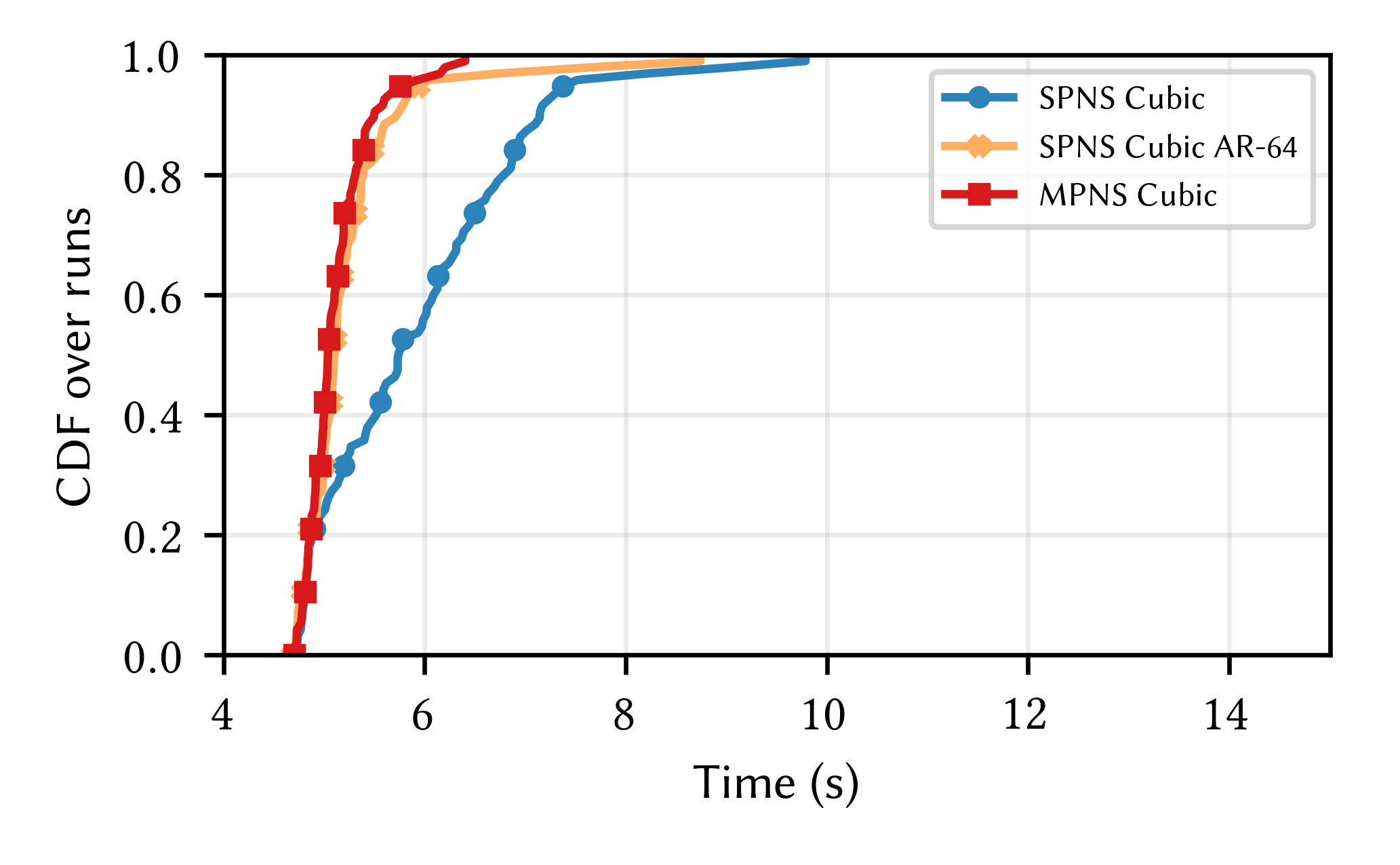
<p>The above figure demonstrate that the picoquic implementation, with its
internal limit of 33 ACK ranges, cannot rely on the SPNS design without
strongly impacting the transfer performance. On the other hand, increasing
this limit to 64 enables the SPNS design to match the MPNS performance.</p>

<p>In the end, both numbering designs can work, but the SPNS one introduces
performance variability due to the receiver’s internals <em>by design</em>. Given
Multipath QUIC may need to serve at some point much more complex network
configurations and scenarios (e.g., spatial communications,…), such a
property is undesirable. This is why this paper argues for considering the
MPNS design for both performance and extension-composability (e.g., ECN,
ACK frequency,…) purposes. With <a href="https://arxiv.org/abs/2210.13663">another study</a>
providing similar observations, this paper convinced the IETF to adopt
the MPNS design in the standardized version of Multipath QUIC.</p>

<p>Note that the artifacts of the paper are available, enabling
the community to reproduce the results presented in the paper.</p>]]></content><author><name>Quentin De Coninck, IP Networking Lab</name></author><category term="inl" /><category term="quic," /><category term="multipath," /><category term="mpquic," /><category term="ietf," /><category term="sigcomm," /><category term="ccr" /><summary type="html"><![CDATA[One of our recent publications in the SIGCOMM Computer Communication Review (CCR) journal, “The Packet Number Space Debate in Multipath QUIC”, has been selected to be part of the “Best of CCR” session at the upcoming ACM SIGCOMM 2023 conference. Let us introduce in this blog post the context in which that work relates and the impact it had regarding the standardisation effort of Multipath QUIC at the IETF.]]></summary><media:thumbnail xmlns:media="http://search.yahoo.com/mrss/" url="https://inl.info.ucl.ac.be/assets/images/pns-mpquic.png" /><media:content medium="image" url="https://inl.info.ucl.ac.be/assets/images/pns-mpquic.png" xmlns:media="http://search.yahoo.com/mrss/" /></entry><entry><title type="html">eBPF in IETF protocols</title><link href="https://inl.info.ucl.ac.be/inl/2023/07/11/ebpf.html" rel="alternate" type="text/html" title="eBPF in IETF protocols" /><published>2023-07-11T00:00:00+00:00</published><updated>2023-07-11T00:00:00+00:00</updated><id>https://inl.info.ucl.ac.be/inl/2023/07/11/ebpf</id><content type="html" xml:base="https://inl.info.ucl.ac.be/inl/2023/07/11/ebpf.html"><![CDATA[<p>In 1992, Steven MacCanne and Van Jacobson proposed the <a href="https://www.tcpdump.org/papers/bpf-usenix93.pdf">BSD Packet
Filter</a>
as an efficient technique to implement flexible packet filters in the
<a href="https://www.tcpdump.org">tcpdump</a> packet capture tool. In a nutshell,
BPF specifies a small instruction set which be used to write programs
that are executed on the captured packets to determine which packets can
be matched. BPF is the standard solution to build powerful packet
filters in <a href="https://www.tcpdump.org">tcpdump</a> and related tools.</p>

<p>Almost 25 years later, Alexei Starovoitov used a similar approach to
design <a href="https://lwn.net/Articles/740157/">extended BPF (eBPF)</a>. <code class="language-plaintext highlighter-rouge">eBPF</code>
is an extension of the original BPF instruction set which is supported
by a virtual machine, a Just-In-Time compiler and a verifier inside the
Linux kernel. With eBPF, it becomes possible to add executable bytecode
inside the Linux kernel to tune its behavior without having to recompile
the kernel or use modules. <code class="language-plaintext highlighter-rouge">eBPF</code> is now widely used inside the Linux
kernel and there are many <a href="https://ebpf.io/what-is-ebpf/">use cases</a>.
<code class="language-plaintext highlighter-rouge">eBPF</code> has also been <a href="https://microsoft.github.io/ebpf-for-windows/">ported to Microsoft
Windows</a>.</p>

<p>To encourage
the adoption of <code class="language-plaintext highlighter-rouge">eBPF</code> in other use cases than the Linux kernel, the
<a href="https://www.ietf.org">IETF</a> has chartered the <a href="https://datatracker.ietf.org/group/bpf/about/">BPF/eBPF working
group</a> to specify the
basic features of this technology, namely the <a href="https://datatracker.ietf.org/doc/draft-thaler-bpf-isa/">eBPF Instruction
Set</a>, the
expectations for the verifier, ...</p>

<table>
  <tbody>
    <tr>
      <td><img src="/assets/images/ebpf-ietf.png" alt="eBPF and the IETF" /></td>
    </tr>
  </tbody>
</table>

<p><code class="language-plaintext highlighter-rouge">eBPF</code> should not be limited to operating system kernels such as Linux
and Windows. There are many other use cases where the extensibility of
<code class="language-plaintext highlighter-rouge">eBPF</code> can be beneficial. The <a href="https://www.ietf.org">IETF</a> spends a lot
of efforts to maintain and slowly extend widely deployed protocols. In
the last years, we have demonstrated that by leveraging <code class="language-plaintext highlighter-rouge">eBPF</code> inside
protocol implementations, it is possible to make them much more
flexible. Here are a few examples that illustrate the flexibility that
<code class="language-plaintext highlighter-rouge">eBPF</code> can bring to IETF protocols.</p>

<p>A first example is <a href="https://www.segment-routing.net">IPv6 Segment Routing or
SRv6</a>. <a href="https://inlold.info.ucl.ac.be/david.html">David
Lebrun</a> has implemented <a href="https://www.segment-routing.org">SRv6 in
the Linux kernel</a> and <a href="https://www.researchgate.net/profile/Mathieu-Xhonneux">Mathieu
Xhonneux</a> added
<a href="https://dial.uclouvain.be/pr/boreal/object/boreal%3A209689/datastream/PDF_01/view">eBPF
features</a>
to this implementation to make it easier to extend.</p>

<p>Our second example is the utilization of eBPF to monitor the networking
stack. This is one of the classical use cases for eBPF today. <a href="https://inlold.info.ucl.ac.be/otilmans.html">Olivier
Tilmans</a> proposed the <a href="https://inlold.info.ucl.ac.be/publications/cop2-continuously-observing-protocol-performance.html">COP2
set of eBPF
programs</a>
to monitor the performance of the networking stack and export the
collected metrics using IPFIX.</p>

<p>Our third example is TCP. TCP is the standard reliable transport
protocol for many applications. <a href="https://inlold.info.ucl.ac.be/hoang.html">Viet-Hoang
Tran</a> showed that it is possible
to leverage eBPF to extend both TCP and Multipath TCP by adding new <a href="https://dial.uclouvain.be/pr/boreal/object/boreal%3A235010/datastream/PDF_01/view">TCP
options in the Linux TCP
stack</a>.
<a href="https://inlold.info.ucl.ac.be/mjadin.html">Mathieu Jadin</a> took a different
approach and proposed the <a href="https://dial.uclouvain.be/pr/boreal/object/boreal%3A260968/datastream/PDF_01/view">TCP Path Changer
(TPC)</a>.
The TPC leverages <code class="language-plaintext highlighter-rouge">eBPF</code> and <code class="language-plaintext highlighter-rouge">IPv6 Segment routing</code> to allow a TCP stack
to react to different types of events by moving established TCP
connections to a different path.</p>

<p><a href="https://www.rfc-editor.org/rfc/rfc9000.html">QUIC</a> is a new IETF
protocol that replaces the classical TLS over TCP stack. It is already
widely deployed by cloud providers. <a href="https://inlold.info.ucl.ac.be/quentin.html">Quentin De
Coninck</a>, <a href="https://inlold.info.ucl.ac.be/mpiraux.html">Maxime
Piraux</a>, <a href="https://inlold.info.ucl.ac.be/fmichel.html">Francois
Michel</a> showed in <a href="https://dial.uclouvain.be/pr/boreal/object/boreal:218857/datastream/PDF_01/view">Pluginizing
QUIC</a>
that it is possible to use <code class="language-plaintext highlighter-rouge">eBPF</code> inside a QUIC implementation to
support various protocol extensions including Multipath, VPN or <a href="https://dial.uclouvain.be/pr/boreal/object/boreal%3A264704/datastream/PDF_01/view">Forward
Erasure
Correction</a>.</p>

<p>Our last example is BGP. BGP is the most important Internet routing
protocol. It slowly evolves. With
<a href="https://www.usenix.org/conference/nsdi23/presentation/wirtgen">xBGP</a>,
<a href="https://inlold.info.ucl.ac.be/thomas.html">Thomas Wirtgen</a> demonstrated
that by adding <code class="language-plaintext highlighter-rouge">eBPF</code> support in the <a href="https://bird.network.cz">BIRD</a> and
<a href="https://frrouting.org">FRRouting</a> implementations it becomes possible
for network operators to develop their own extensions to the BGP
protocol and execute them as <code class="language-plaintext highlighter-rouge">eBPF program</code>.</p>

<p>Once the <a href="https://wwww.ietf.org">IETF</a> <a href="https://datatracker.ietf.org/group/bpf/about/">BPF/eBPF working
group</a> has finished the
standardization of the basics of <code class="language-plaintext highlighter-rouge">eBPF</code> the <a href="https://www.ietf.org">IETF</a>
should start to discuss the utilization of <code class="language-plaintext highlighter-rouge">eBPF</code> inside various
Internet protocols.</p>]]></content><author><name>Olivier Bonaventure, IP Networking Lab</name></author><category term="inl" /><category term="quic," /><category term="ebpf," /><category term="bgp," /><category term="tcp," /><category term="srv6" /><summary type="html"><![CDATA[In 1992, Steven MacCanne and Van Jacobson proposed the BSD Packet Filter as an efficient technique to implement flexible packet filters in the tcpdump packet capture tool. In a nutshell, BPF specifies a small instruction set which be used to write programs that are executed on the captured packets to determine which packets can be matched. BPF is the standard solution to build powerful packet filters in tcpdump and related tools.]]></summary><media:thumbnail xmlns:media="http://search.yahoo.com/mrss/" url="https://inl.info.ucl.ac.be/assets/images/ebpf-ietf.png" /><media:content medium="image" url="https://inl.info.ucl.ac.be/assets/images/ebpf-ietf.png" xmlns:media="http://search.yahoo.com/mrss/" /></entry><entry><title type="html">xBGP: Faster Innovation in Routing Protocols.</title><link href="https://inl.info.ucl.ac.be/inl/2023/05/12/xbgp.html" rel="alternate" type="text/html" title="xBGP: Faster Innovation in Routing Protocols." /><published>2023-05-12T00:00:00+00:00</published><updated>2023-05-12T00:00:00+00:00</updated><id>https://inl.info.ucl.ac.be/inl/2023/05/12/xbgp</id><content type="html" xml:base="https://inl.info.ucl.ac.be/inl/2023/05/12/xbgp.html"><![CDATA[<p>From April 17 to 19, the NSDI23’ conference was held in Boston, during which we presented our paper titled “xBGP: Faster Innovation in Routing Protocols.”</p>

<p>In this post we will explore the outlines of xBGP.</p>

<!--more-->

<h1 id="the-need-of-programability-in-routing-protocols">The Need of programability in routing protocols</h1>

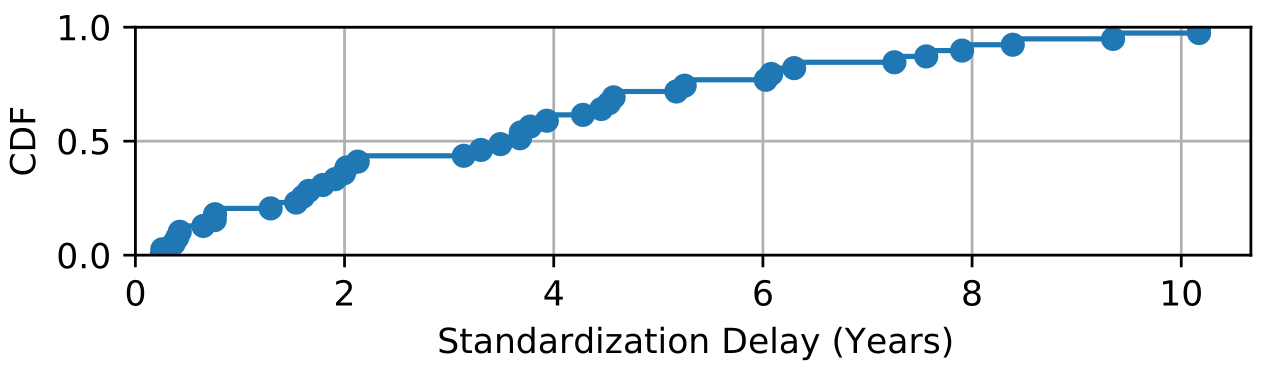
<p>Whether at the level of the end user or the network operator, there is a constant need to extend the services provided by the network. This often leads to the addition of new features in the protocols used by the network equipment. In order to meet these requirements, widely used session-oriented Internet protocols, such as TCP or BGP, incorporate feature negotiation mechanisms during their handshake. Networks are made up of devices from different vendors, each with its own implementation and specific hardware architecture, influenced by various factors such as economics. To ensure compatibility between these different network nodes, the Internet relies on standards developed by the IETF. Although these protocols are designed to be scalable, the introduction of new extensions requires a standardization process before they can be incorporated into network node implementations. However, this process can take time. Figure 1 shows the delay in publishing BGP extensions in RFCs. The median time is 3.5 years, and some features have taken up to 10 years to be standardized.</p>

<table>
  <thead>
    <tr>
      <th style="text-align: center"><img src="/assets/images/inl/xbgp/ietf_delay.png" alt="Figure 1 — Delay between the publication of the first IETF draft and the published version of the last 40 BGP RFCs." /></th>
    </tr>
  </thead>
  <tbody>
    <tr>
      <td style="text-align: center"><em>Figure 1 — Delay between the publication of the first IETF draft and the published version of the last 40 BGP RFCs.</em></td>
    </tr>
  </tbody>
</table>

<p>To address this limitation, we introduce xBGP, a paradigm shift that allows all BGP implementations to be programmable. This allows network operators to develop and experiment with new features before standardization. By using a programmable protocol, networks gain flexibility and agility. This results in faster deployment of new services and better compatibility between routers. In addition, the introduction of xBGP allows for more sophisticated services to be implemented between Autonomous Systems (AS), thus improving the overall quality of routing.</p>

<h1 id="how-xbgp-works">How xBGP works</h1>

<p>xBGP allows network operators to adapt to changing needs and offer better services to their customers by implementing their own xBGP program. They can introduce new features or enhance existing ones by leveraging the capabilities of xBGP. There are several elements of xBGP that help achieve this goal:</p>

<p>First, xBGP integrates an eBPF virtual machine to dynamically inject platform-independent bytecode. This allows to interface with any BGP implementation without having to adapt to the router architecture. The new features implemented by the operator will be compatible regardless of the router.</p>

<p>Second, all xBGP-enabled routers include a vendor-independent API. This API provides access to the internal components and data structures of BGP. If necessary, xBGP performs a conversion of the internal representation into its own format before providing data to xBGP programs, and vice versa.</p>

<p>Third, to talk BGP with another router, all BGP implementations must follow the protocol specification defined in <a href="https://datatracker.ietf.org/doc/html/rfc4271">RFC4271</a>. This specification describes the structure of BGP messages, a finite-state BGP conceptual machine responsible for processing individual BGP sessions, an abstract BGP workflow and data structures that detail the procedure for processing BGP update and delete messages.</p>

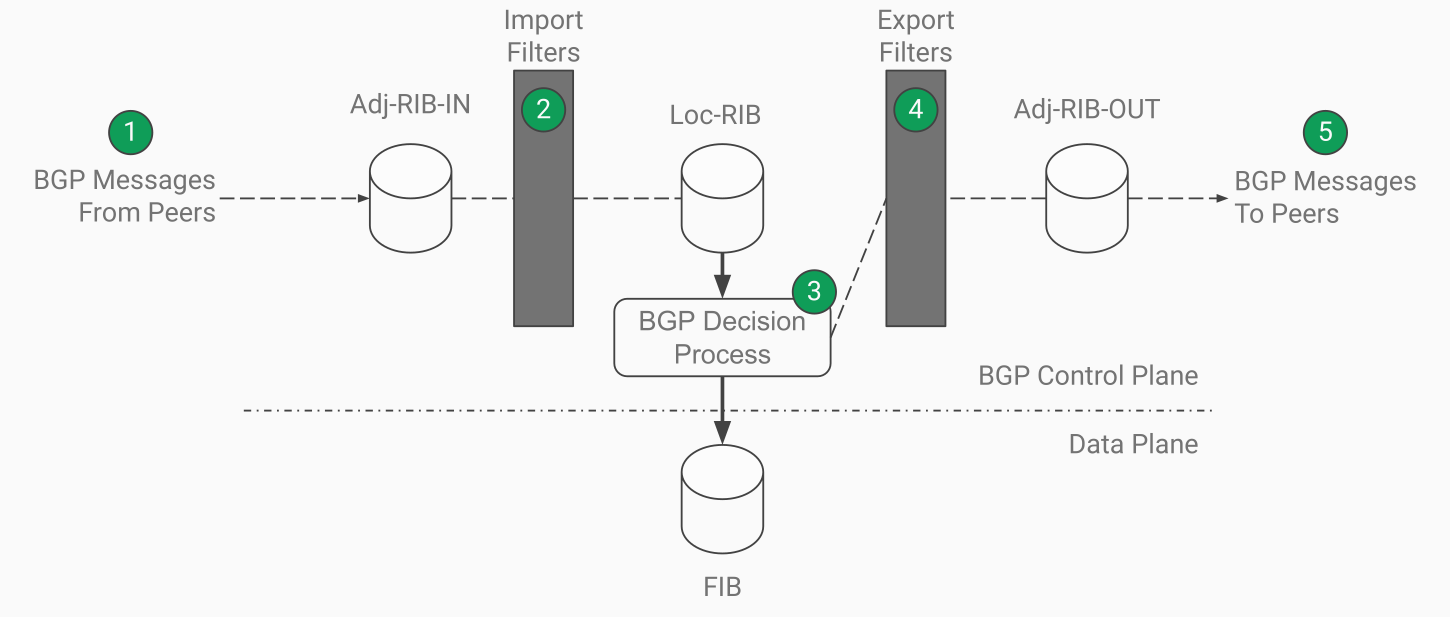
<p>xBGP uses the BGP workflow definition to place insertion points (green circles in Figure 2). Insertion points are the locations in the BGP implementation where the xBGP program can be run. The BGP workflow includes the following steps:</p>

<table>
  <thead>
    <tr>
      <th style="text-align: center"><img src="/assets/images/inl/xbgp/workflow.png" alt="Figure 2 — BGP Workflow with xBGP Insertion Points (green circles)." /></th>
    </tr>
  </thead>
  <tbody>
    <tr>
      <td style="text-align: center"><em>Figure 2 — BGP Workflow with xBGP Insertion Points (green circles).</em></td>
    </tr>
  </tbody>
</table>

<ol>
  <li>The Router receives BGP messages from its peers.</li>
  <li>If it’s a BGP UPDATE, the router checks the message on the importation filters. If the route meets the import policies, it’s added to the theoritical Adj-RIB-in.</li>
  <li>Accepted routes are inserted to the Loc-RIB, which stores routes from all neighboring BGP speakers. The BGP decision process is run to select one best BGP route per prefix.</li>
  <li>Routes are subjected to export filters before being sent as BGP updates to neighboring routers. If a route passes the export filters, it is included in the theoretical Adj-RIB-Out</li>
  <li>Finally the routes are sent to BGP neighbors.</li>
</ol>

<h1 id="safely-injecting-xbgp-program-into-the-host-implementation">Safely injecting xBGP program into the host implementation</h1>

<p>From the operator’s perspective, injecting an xBGP program is risky because the program can cause a router to fail. This risk is considered unacceptable because BGP implementations are generally expected to run continuously without interruption, typically 24 hours a day, 7 days a week.</p>

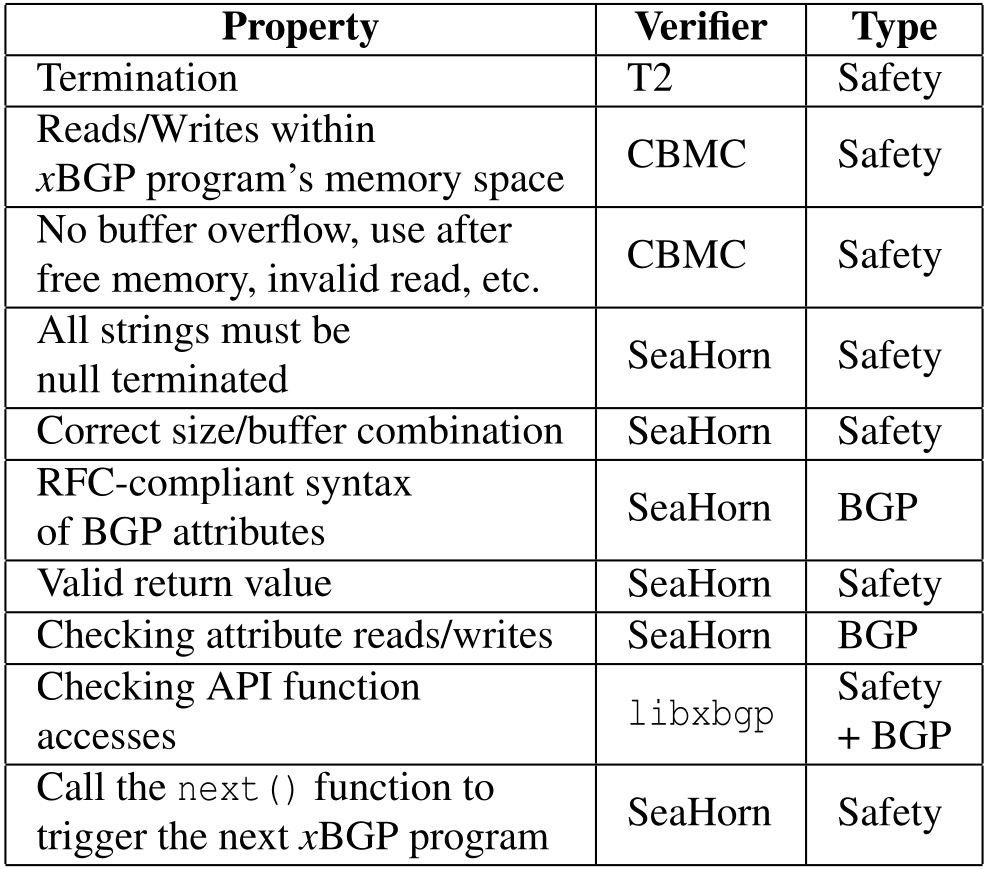
<p>xBGP uses verification techniques to ensure the safe injection of programs. To do this, we (i) define a set of properties that a program must meet to be considered safe, and (ii) use a toolchain consisting of three well-established and widely tested software verification tools - SeaHorn, CBMC, and T2. Table 1 illustrates the different properties verified by our tool chain and the corresponding verifiers used for verification.</p>

<table>
  <thead>
    <tr>
      <th style="text-align: center"><img src="/assets/images/inl/xbgp/verif.png" alt="Table 1 — Properties that xBGP programs must satisfy." /></th>
    </tr>
  </thead>
  <tbody>
    <tr>
      <td style="text-align: center"><em>Table 1 — Properties that xBGP programs must satisfy.</em></td>
    </tr>
  </tbody>
</table>

<h1 id="use-cases">Use Cases</h1>

<p>To demonstrate the benefits of xBGP, we have implemented different categories of problems that operators want to solve. Some of them can be solved without the help of xBGP, but others are really complex to solve without xBGP. For example, we have implemented:</p>

<ul>
  <li>
    <p>a mechanism that detects zombie routes. These are routes that are installed in the routing table but are no longer reachable.</p>
  </li>
  <li>
    <p>a way to control path diversity.  Each time a route is chosen, an xBGP program increases an internal counter, repeating this process for each BGP decision step. When a route is advertised to a peer, that statistic is joined as a BGP community. The BGP router receiving the route can use these statistics to better understand the current routing table of its peer. If all routes were determined only by the last step of the BGP decision process, this indicates a lack of path diversity.</p>
  </li>
</ul>

<p>With xBGP design, operators have the ability to quickly design and introduce the features they want into the network, even before they are implemented by the vendor.</p>

<h1 id="read-more">Read More</h1>

<p>If you are interested in learning more about the internals of xBGP, the possible use cases, and the verification toolchain, please refer to <a href="https://www.usenix.org/conference/nsdi23/presentation/wirtgen">our article published in the NSDI23 conference</a>.</p>

<p><em>Thomas Wirtgen, Tom Rousseaux, Quentin De Coninck, and Nicolas Rybowski, ICTEAM, UCLouvain; Randy Bush, Internet Initiative Japan &amp; Arrcus, Inc; Laurent Vanbever, NSG, ETH Zürich; Axel Legay and Olivier Bonaventure, ICTEAM, UCLouvain</em></p>

<p>This work was partially supported by the French Community of Belgium through the funding of a FRIA (Fund for Research training in Industry and Agriculture) grant.</p>]]></content><author><name>Thomas Wirtgen, IP Networking Lab</name></author><category term="inl" /><category term="inl" /><category term="xBGP" /><category term="BGP" /><category term="programmable" /><category term="routing" /><category term="protocol" /><summary type="html"><![CDATA[From April 17 to 19, the NSDI23’ conference was held in Boston, during which we presented our paper titled “xBGP: Faster Innovation in Routing Protocols.” In this post we will explore the outlines of xBGP.]]></summary><media:thumbnail xmlns:media="http://search.yahoo.com/mrss/" url="https://inl.info.ucl.ac.be/assets/images/inl/xbgp/xbgp.png" /><media:content medium="image" url="https://inl.info.ucl.ac.be/assets/images/inl/xbgp/xbgp.png" xmlns:media="http://search.yahoo.com/mrss/" /></entry><entry><title type="html">The multiple of roles that IPv6 can play in today’s Internet</title><link href="https://inl.info.ucl.ac.be/inl/2023/04/13/the-multiple-roles-of-ipv6.html" rel="alternate" type="text/html" title="The multiple of roles that IPv6 can play in today’s Internet" /><published>2023-04-13T00:00:00+00:00</published><updated>2023-04-13T00:00:00+00:00</updated><id>https://inl.info.ucl.ac.be/inl/2023/04/13/the-multiple-roles-of-ipv6</id><content type="html" xml:base="https://inl.info.ucl.ac.be/inl/2023/04/13/the-multiple-roles-of-ipv6.html"><![CDATA[<p>While IPv6 has been standardised in 1998 and its deployment is progressing to overcome the exhaustion of IPv4 addresses, the way IP addresses are used today remains identical to early days of the Internet. We argue that several changes in the Internet infrastructure in the last decade combined with the large addressing space of IPv6 enables opportunities in privacy, mobility, server performance, multihoming, segment routing, differentiated routing and multicast.</p>

<!--more-->

<p>During the last decade, applications and transport protocols became further decoupled from the network layer. First, multipath transport protocols such as SCTP, MPTCP, QUIC and MPQUIC are able to use several network paths in the same transport connection. Second, applications leverage TLS to secure their communications and rarely use IP addresses to authenticate their users and services. These two can be combined to reconsider the semantics of IPv6 addresses further than simply identifying a network interface.</p>

<p>In this post we will explore how the roles that IPv6 addresses can play to improve the load-balancing and performance of servers as well as solve the multihoming problem in a more efficient and scalable way.</p>

<h1 id="multicore-dataplane">Multicore dataplane</h1>

<table>
  <thead>
    <tr>
      <th style="text-align: center"><img src="/assets/images/inl/ccr-ipv6/ipv6-multicore.svg" alt="Figure 1 — Having one IP per core enables a better load-balancing than hashing packet identifiers." /></th>
    </tr>
  </thead>
  <tbody>
    <tr>
      <td style="text-align: center"><em>Figure 1 — Having one IP per core enables a better load-balancing than hashing packet identifiers.</em></td>
    </tr>
  </tbody>
</table>

<p>Over the last decade, servers have greatly evolved too and now reach hundreds of CPU cores. Today, when the network card has a single IP address, incoming traffic is spread between the cores using techniques such as RSS that hashes the 4-tuple of incoming packets to assign a CPU core to each flow. This represents an additional burden on the NIC and CPUs, but can also lead to a high load imbalance. Using IPv6, one IPv6 can be assigned per CPU core. Then the NIC can forward packets directly to the right CPU core without requiring them to go through dispatching CPU cores first.</p>

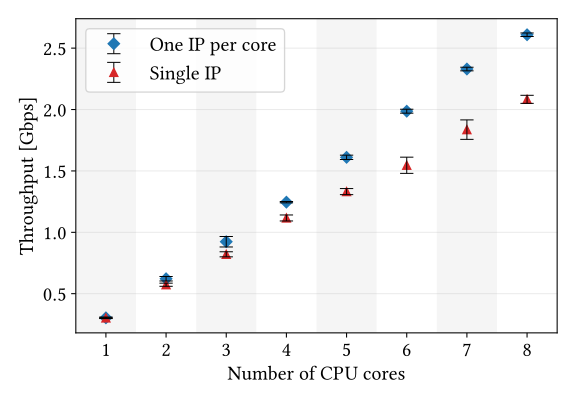
<p>Figure 1 illustrates the throughput of a modified QUIC implementation using DPDK and two variants of IPv6 usage in our test bed when serving 128 clients. First, the <em>Single IP</em> variant represents the usage of a single server IPv6 address as widely used on the Internet today. In this case, the server uses RSS to dispatch packets to cores. Second, the <em>One IP per core</em> variant represents our usage of one IPv6 address per core. In this case, the clients use the DNS to randomly select one of the IPv6 addresses. When incoming packets arrive at the server NIC, it simply addresses them at their corresponding core. We can observe that with 8 CPU cores, the throughput can be increased by 25%.</p>

<h1 id="multihoming-with-provider-aggregatable-ipv6-addresses">Multihoming with Provider-Aggregatable IPv6 addresses</h1>

<table>
  <thead>
    <tr>
      <th style="text-align: center"><img src="/assets/images/inl/ccr-ipv6/ipv6-host-based-multihoming.svg" alt="Figure 2 — Host-based multihoming enable the client and server to use one path per provider for more diversity and resilience." /></th>
    </tr>
  </thead>
  <tbody>
    <tr>
      <td style="text-align: center"><em>Figure 2 — Host-based multihoming enable the client and server to use one path per provider for more diversity and resilience.</em></td>
    </tr>
  </tbody>
</table>

<p>The growth of the Internet is also reflected in the growth of the Autonomous Systems (AS). Today, a BGP router can interact with more than 70k ASes and has to process a million of routes towards the prefixes that they announce. While most networks are usually first connected to the Internet through a single provider, many enterprise and organisation networks are becoming multihomed. To achieve this, they obtain an AS number and use BGP to advertise their own prefix to the global Internet. This approach is not scalable as it contributes to the growth of BGP routing tables.</p>

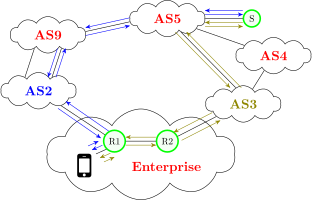
<p>IPv6 enables us to reconsider this problem. Let us consider Figure 2 which depicts an enterprise network becoming multihomed using two providers. With IPv6, the network obtains one Provider-Aggregatable IPv6 prefix from each of its provider. It does not need to become an AS or use BGP. It also enables hosts to use different interdomain paths to communicate. Figure 2 illustrates two of such paths between a client in the enterprise network and a server connected to AS5. Multipath transport protocols can select the best performing one given some application requirements and use the two paths simultaneously. They also improve the resiliency of hosts, as when a link fails, for instance the link towards AS2, the multipath transport connection can continue via AS3.</p>

<p>Switching from BGP to host-based multihoming would also greatly reduce the number of BGP messages coming from stub ASes, as the ASes solely existing for multihoming purposes could disappear. From a security perspective, this could also improve the relative adoption of RPKI, as stub ASes have a lower RPKI adoption than transit ASes.</p>

<h1 id="read-more">Read more</h1>

<p>If you’re interested reading more on how IPv6 enables opportunities in privacy, mobility, segment routing, differentiated routing and multicast, please refer to our article published in <a href="https://ccronline.sigcomm.org/2022/ccr-july-2022/the-multiple-roles-that-ipv6-addresses-can-play-in-todays-internet/">the July 2022 issue of the ACM SIGCOMM Computer Communication Review</a>.</p>

<p><em>Maxime Piraux, Tom Barbette, Nicolas Rybowski, Louis Navarre, Thomas Alfroy, Cristel Pelsser, François Michel, Olivier Bonaventure (2022). The multiple roles that IPv6 addresses can play in today’s internet. ACM SIGCOMM Computer Communication Review, 52(3), 10-18.</em></p>

<p><em>This paper was partially supported by the NGI-POINTER programme with funding from the European Union’s Horizon 2020 research and innovation programme under the Grant Agreement no 825354, the FSR Fellowship from UCLouvain, the F.R.S.-FNRS Research Fellowship, the ArtIC project “Artificial Intelligence for Care” (grant ANR-20-THIA-0006-01) and co funded by Région Grand Est, Inria Nancy - Grand Est, IHU of Strasbourg, University of Strasbourg and University of Haute-Alsace.</em></p>]]></content><author><name>Maxime Piraux, IP Networking Lab</name></author><category term="inl" /><category term="inl" /><category term="ip" /><category term="ipv6" /><category term="multihoming" /><category term="multipath" /><category term="transport" /><category term="protocol" /><summary type="html"><![CDATA[While IPv6 has been standardised in 1998 and its deployment is progressing to overcome the exhaustion of IPv4 addresses, the way IP addresses are used today remains identical to early days of the Internet. We argue that several changes in the Internet infrastructure in the last decade combined with the large addressing space of IPv6 enables opportunities in privacy, mobility, server performance, multihoming, segment routing, differentiated routing and multicast.]]></summary><media:thumbnail xmlns:media="http://search.yahoo.com/mrss/" url="https://inl.info.ucl.ac.be/assets/images/inl/ccr-ipv6/listing.jpg" /><media:content medium="image" url="https://inl.info.ucl.ac.be/assets/images/inl/ccr-ipv6/listing.jpg" xmlns:media="http://search.yahoo.com/mrss/" /></entry><entry><title type="html">RPKI Time-of-Flight: Tracking Delays in the Management, Control, and Data Planes</title><link href="https://inl.info.ucl.ac.be/mise/2023/04/12/RPKI-tracking-time.html" rel="alternate" type="text/html" title="RPKI Time-of-Flight: Tracking Delays in the Management, Control, and Data Planes" /><published>2023-04-12T00:00:00+00:00</published><updated>2023-04-12T00:00:00+00:00</updated><id>https://inl.info.ucl.ac.be/mise/2023/04/12/RPKI-tracking-time</id><content type="html" xml:base="https://inl.info.ucl.ac.be/mise/2023/04/12/RPKI-tracking-time.html"><![CDATA[<p>What is the life cycle of Resource Public Key Infrastructure (RPKI) data used to secure Internet routing? More specifically, how long does a Route Origin Authorization (ROA) take to propagate and how quickly does it actually affect Internet routing and reachability?</p>

<p>These are questions we would love to have answers to, given that changes on the RPKI management plane can impact how traffic flows. To answer these questions we dissect the stages in the life of RPKI data.</p>

<!--more-->

<p>Below is a summary of the RPKI lifecycle and our findings.</p>

<p>Key points:</p>
<ul>
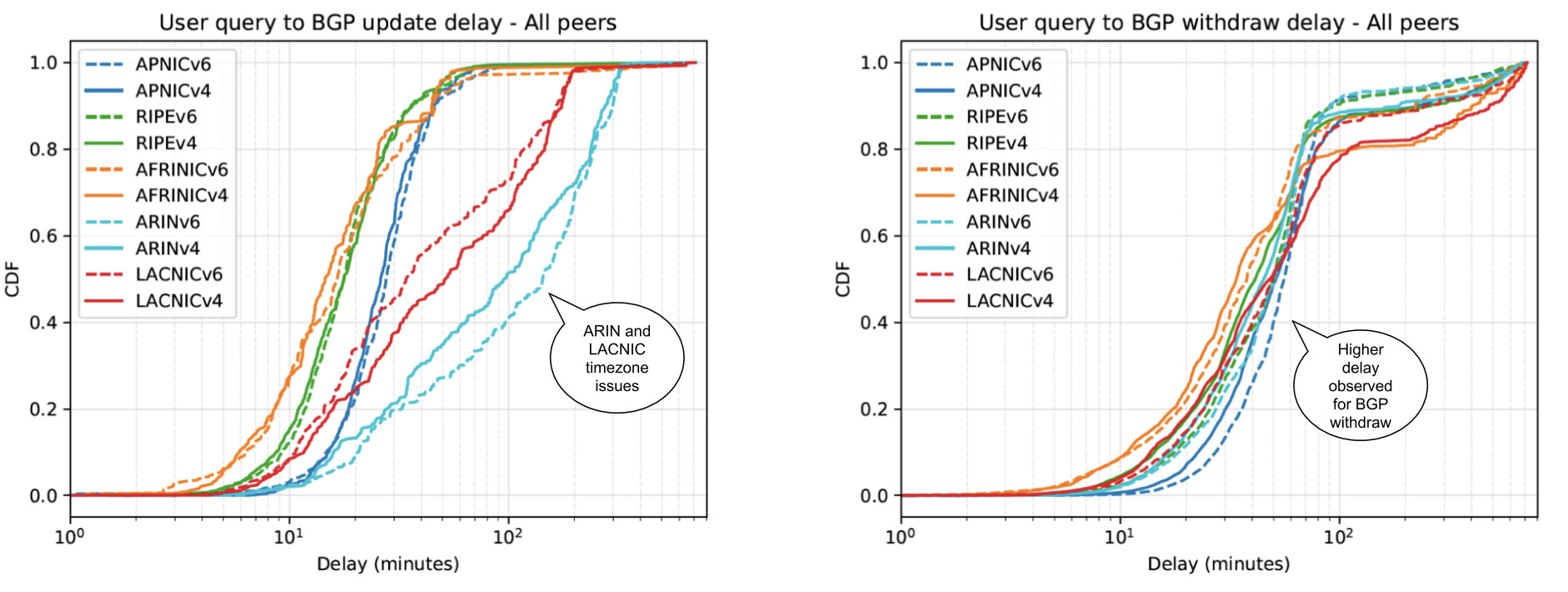
  <li>Creation times vary significantly across the Regional Internet Registries (RIRs), ranging from a few minutes to over an hour for new ROAs to reach the publication points.</li>
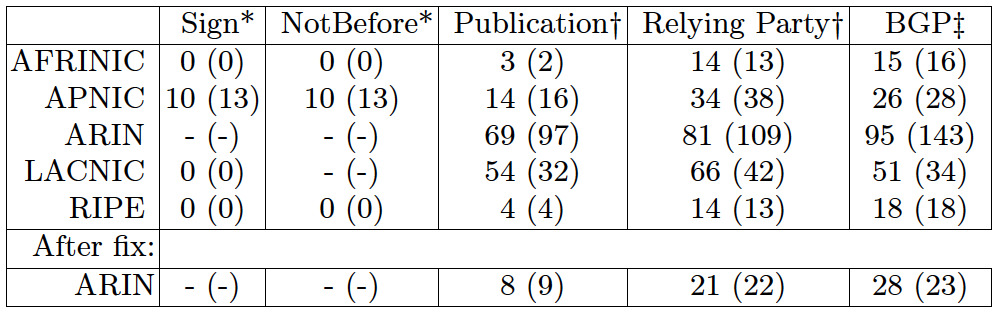
  <li>High publication delays were initially observed for ARIN and LACNIC due to a timezone issue. The problem has been reported and is now fixed. Observed delays are usually less than 20min.</li>
  <li>Relying Party (RP) delay represents the most time-consuming step observed in ROA processing.</li>
  <li>Deleting ROAs takes longer to reflect in BGP as routers explore alternate routes that have not yet been invalidated.</li>
</ul>

<h1 id="rov-supply-chain">ROV supply chain</h1>

<p>Publishing ROAs involves a large number of players, is not instantaneous, and is often dominated by ad hoc administrative decisions.</p>

<p>It starts when a resource holder queries an RIR to create or update RPKI information for its prefixes. The ROAs and other meta files (manifests, CRLs) are then placed in public repositories called publication points.</p>

<p>RPs periodically fetch and validate all the objects from the global RPKI repositories, after which they produce a list of Validated ROA Payloads (VRPs) that routers use to verify incoming BGP announcements. These changes are fetched by operators performing Route Origin Validation (ROV-enabled ASes, green in Fig.1) that use this new information to update their routers. Only then do changes appear on the data plane when routing announcements are either accepted or dropped by ROV-enabled ASes.</p>

<table>
  <thead>
    <tr>
      <th style="text-align: center"><img src="/assets/images/roa-time-analysis.pdf" alt="Figure 1 — Data flow from the creation of a ROA by the prefix holder to the corresponding BGP updates are recorded at the route collectors (RIS / RouteViews). The red labels on the left show the points at which time measurements were taken." /></th>
    </tr>
  </thead>
  <tbody>
    <tr>
      <td style="text-align: center"><em>Figure 1 — Data flow from the creation of a ROA by the prefix holder to the corresponding BGP updates are recorded at the route collectors (RIS / RouteViews). The red labels on the left show the points at which time measurements were taken.</em></td>
    </tr>
  </tbody>
</table>

<h1 id="delay-differences-between-roa-creation-and-deletion">Delay differences between ROA creation and deletion</h1>

<p>Each of the above steps is common to all RIRs and ROV-enabled ASes, but each (may) perform these steps at different time intervals and frequencies.</p>

<p>In our study, we found that RIRs usually publish new RPKI information within five minutes, except APNIC which averages ten minutes slower (Table 1, column 3). We also observed significant disparities in ISPs’ reaction time to new RPKI information, ranging from a few minutes to one hour.</p>

<table>
  <thead>
    <tr>
      <th style="text-align: center"><img src="/assets/images/ROA-creation.jpg" alt="Table 1— ROA Creation median delays (IPv6 in parentheses)." /></th>
    </tr>
  </thead>
  <tbody>
    <tr>
      <td style="text-align: center"><em>Table 1— ROA Creation median delays (IPv6 in parentheses).</em></td>
    </tr>
  </tbody>
</table>

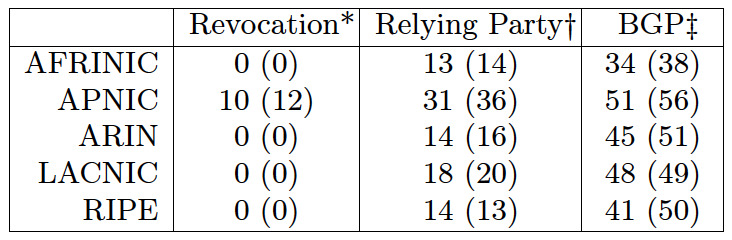
<p>When deleting ROAs, we found the delay to be significantly longer (Table 2) except for ARIN and LACNIC (we explain why these differ below). For ROA revocation, we observed that the delay between ROA deletion and unreachability varies depending on the topology. Again, BGP delays are significantly higher for ROA deletion than for ROA creation. For example, BGP delay for unreachability goes up to 51 minutes for IPv4 and 56 minutes for IPv6 and we rarely observe short BGP delays. We proposed two possible causes for this:</p>

<p>Using multiple RP caches (for redundancy) is likely to react significantly slower to ROA deletion than to ROA creation. 
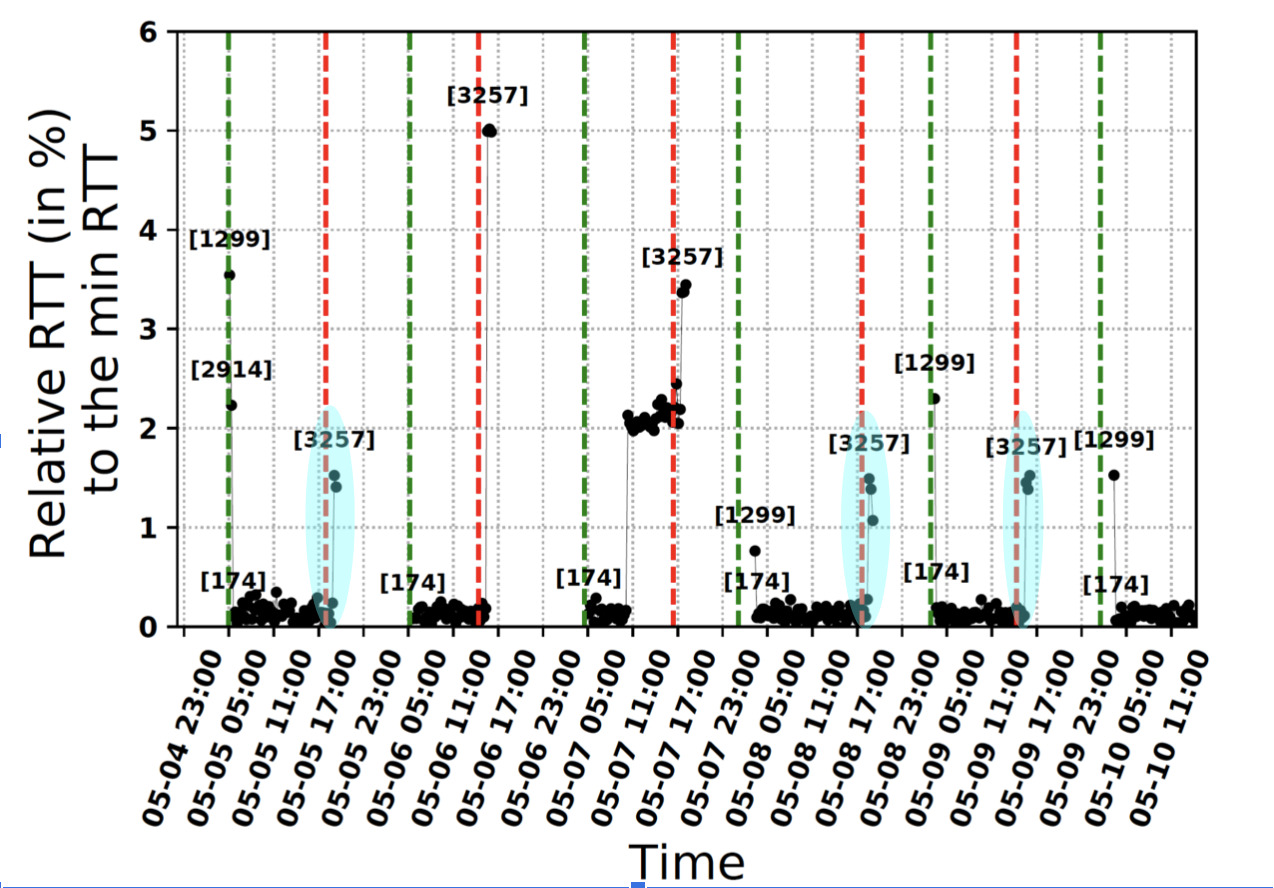
BGP path hunting (Figure 3): in some cases, we observed that the AS path between the RIPE Atlas probe and the destination changed before becoming unreachable.</p>

<table>
  <thead>
    <tr>
      <th style="text-align: center"><img src="/assets/images/ROA-deletion.jpg" alt="Table 2— ROA deletion median delays (IPv6 in parentheses)." /></th>
    </tr>
  </thead>
  <tbody>
    <tr>
      <td style="text-align: center"><em>Table 2— ROA deletion median delays (IPv6 in parentheses).</em></td>
    </tr>
  </tbody>
</table>

<table>
  <thead>
    <tr>
      <th style="text-align: center"><img src="/assets/images/CDF-ROA-creation-deletion.jpg" alt="Figure 2 — Difference between ROA creation and deletion." /></th>
    </tr>
  </thead>
  <tbody>
    <tr>
      <td style="text-align: center"><em>Figure 2 — Difference between ROA creation and deletion.</em></td>
    </tr>
  </tbody>
</table>

<h1 id="arin-and-lacnic-timezone-issues">ARIN and LACNIC timezone issues</h1>

<p>Before April 2022, the publication delay for ARIN and LACNIC could last several hours due 
to a time zone conversion problem.</p>

<p>Both RIRs intended to set ROAs’ NotBefore values to midnight, but instead, ARIN has been setting this value to 04:00 UTC or 05:00 UTC (corresponding respectively to 00:00 in Eastern Daylight Time and Eastern Standard Time) and LACNIC to 03:00 UTC (corresponding to 00:00 in Uruguay Standard Time).</p>

<p>For example, a query at 01:00 UTC to create a ROA in LACNIC would create a ROA with a NotBefore value set to 03:00 UTC. Therefore, the ROA would be invalid for the two hours following its creation. Our experiment revealed that the publication point wisely does not publish the ’not-yet-valid’ ROA to the repository, therefore, delaying its availability to RPs. The same holds for ARIN.</p>

<p>We reported this issue to both ARIN and LACNIC, who promptly acknowledged and fixed the problem.</p>

<h1 id="data-plane-measurements">Data Plane Measurements</h1>

<p>As more ROAs are created to protect prefixes from being mis-originated, one wonders how long it takes for the effect of RPKI changes to appear in the data plane.</p>

<p>To achieve the above, we used a ‘toggling ROAs’ mechanism, where we use an “invalidating” ROA with AS666 to keep the RPKI status of our advertised prefixes “invalid”.  We would then change the RPKI status “valid &lt;-&gt; invalid” of the test prefixes by either creating a “validating” ROA with a proper authorized origin AS or deleting the ROA.</p>

<p>To test data plane reachability and the delay of prefixes with toggling ROAs, we performed traceroutes every 15 minutes from RIPE Atlas with probes in six different ASes. When creating a “validating ROA”, the delay between the user query and data plane reachability is similar to BGP. We observe a median delay between 23 minutes (RIPE) and 50 minutes (APNIC).</p>

<table>
  <thead>
    <tr>
      <th style="text-align: center"><img src="/assets/images/Toggling-traceroutes.jpg" alt="Figure 3 — Effects of ROA creation/deletion on the data plane. We observe BGP path hunting with AS path changes." /></th>
    </tr>
  </thead>
  <tbody>
    <tr>
      <td style="text-align: center"><em>Figure 3 — Effects of ROA creation/deletion on the data plane. We observe BGP path hunting with AS path changes.</em></td>
    </tr>
  </tbody>
</table>

<h1 id="rp-delay-possible-bottleneck">RP Delay: Possible Bottleneck?</h1>

<p>RPs periodically fetch RPKI data from publications points.</p>

<p>We found that the RP delay represents the most time-consuming step observed in ROA processing. The delay we observed between the ROA creation and the time when an RP validates the new ROA is usually less than 15 minutes for most RIRs. This represents 10 minutes more than the publication delay and consists mainly of the:</p>
<ul>
  <li>Polling interval (5 minutes delay on average)</li>
  <li>Downloading time from all Certification Authorities (4 minutes)</li>
  <li>ROA processing time (1 minute). 
There are other factors that can potentially affect RP delays such as varying downloading times due to networking conditions, publication point time-outs, or lack of multi-threading support in some RP software.</li>
</ul>

<h1 id="read-more">Read more</h1>

<p>Romain Fontugne, Amreesh Phokeer, Cristel Pelsser, Kevin Vermeulen, Randy Bush (2023). RPKI Time-of-Flight: Tracking Delays in the Management, Control, and Data Planes. Passive and Active Measurement.</p>

<p><a href="https://cristel.pelsser.eu/publication/fontugne-2023/fontugne-2023.pdf">paper</a> ; <a href="https://github.com/romain-fontugne/rov-timing">github</a> ; <a href="https://www.youtube.com/watch?v=aoXpiC_ggj8">video</a></p>

<p><em>This study was partly funded by the MANRS Fellowship program and was a collaboration between IIJ Research Lab, Internet Society, UCLouvain, LAAS-CNRS, and Arrcus Inc.</em></p>]]></content><author><name></name></author><category term="mise" /><category term="mise" /><category term="RPKI" /><category term="ROA" /><category term="ROV" /><category term="timing" /><summary type="html"><![CDATA[What is the life cycle of Resource Public Key Infrastructure (RPKI) data used to secure Internet routing? More specifically, how long does a Route Origin Authorization (ROA) take to propagate and how quickly does it actually affect Internet routing and reachability? These are questions we would love to have answers to, given that changes on the RPKI management plane can impact how traffic flows. To answer these questions we dissect the stages in the life of RPKI data.]]></summary><media:thumbnail xmlns:media="http://search.yahoo.com/mrss/" url="https://inl.info.ucl.ac.be/assets/images/roa-time-analysis.pdf" /><media:content medium="image" url="https://inl.info.ucl.ac.be/assets/images/roa-time-analysis.pdf" xmlns:media="http://search.yahoo.com/mrss/" /></entry></feed>